Patterns Become Easier When You Know Where to Look
Pattern recognition puzzles ask a simple but powerful question: what rule connects these things? The things may be numbers, shapes, colors, positions, rotations, sizes, letters, or mixed symbols. At first, a pattern can look like a row of unrelated objects. Then one feature begins to repeat, change, alternate, mirror, grow, or disappear. The puzzle opens when the solver finds the rule that explains the whole set. Strong pattern solving is not about staring harder. It is about checking the right kinds of change in a careful order.
A: Identify the goal, list the given information, and look for the clearest constraint.
A: Testing is useful; unsupported guessing is usually less helpful than narrowing possibilities.
A: Use one after you have tried several fair approaches and no longer have a testable idea.
A: The answer should make earlier clues feel purposeful once explained.
A: Change methods: sort, draw, reread, explain aloud, or step away briefly.
A: Not always. The best puzzle is the one whose difficulty fits the solver and setting.
A: Teams combine observation, memory, organization, and different puzzle habits.
A: Clear goals, fair constraints, useful feedback, and an earned breakthrough.
A: They can practice specific skills, especially when the challenge is varied and sustained.
A: Notice which clues mattered, which assumptions failed, and which method helped most.
What Pattern Puzzles Are Really Testing
Pattern recognition puzzles test the ability to notice relationships. They are not only about visual sharpness or math skill. A solver must decide which features matter and which are noise. That choice is the heart of the puzzle. If you track the wrong feature, the sequence stays confusing. If you track the right feature, the rule may become almost obvious.
This is why pattern puzzles appear in so many places: puzzle books, classroom activities, aptitude tests, brain games, and recreational challenges. They compress reasoning into a small space. A few shapes or terms can reveal how carefully a person compares, tests, and revises ideas.
Start With Observable Features
Before naming a rule, describe what you can see. In a shape puzzle, count sides, corners, filled areas, rotations, and positions. In a number sequence, compare differences, ratios, alternations, and term positions. In a mixed puzzle, separate color, shape, size, and location. Listing features prevents the mind from grabbing the first attractive idea and refusing to let go.
Observable features also keep the solve fair. A good rule should be supported by the items shown, not by a hidden story the solver invents. If your explanation requires too many special exceptions, the rule is probably not the intended one.
Simple Rules First
The best first tests are simple: repetition, alternation, increase, decrease, rotation, reflection, movement, and count. These rule families appear often because they are easy to represent and satisfying to discover. A solver who checks them systematically will solve many puzzles without needing exotic logic.
Simple does not mean shallow. A puzzle may combine two simple rules in a clever way. A shape may rotate while its fill alternates. A number may increase on odd terms and decrease on even terms. The rule becomes challenging because features interact, not because each feature is difficult alone.
Sequences and Alternation
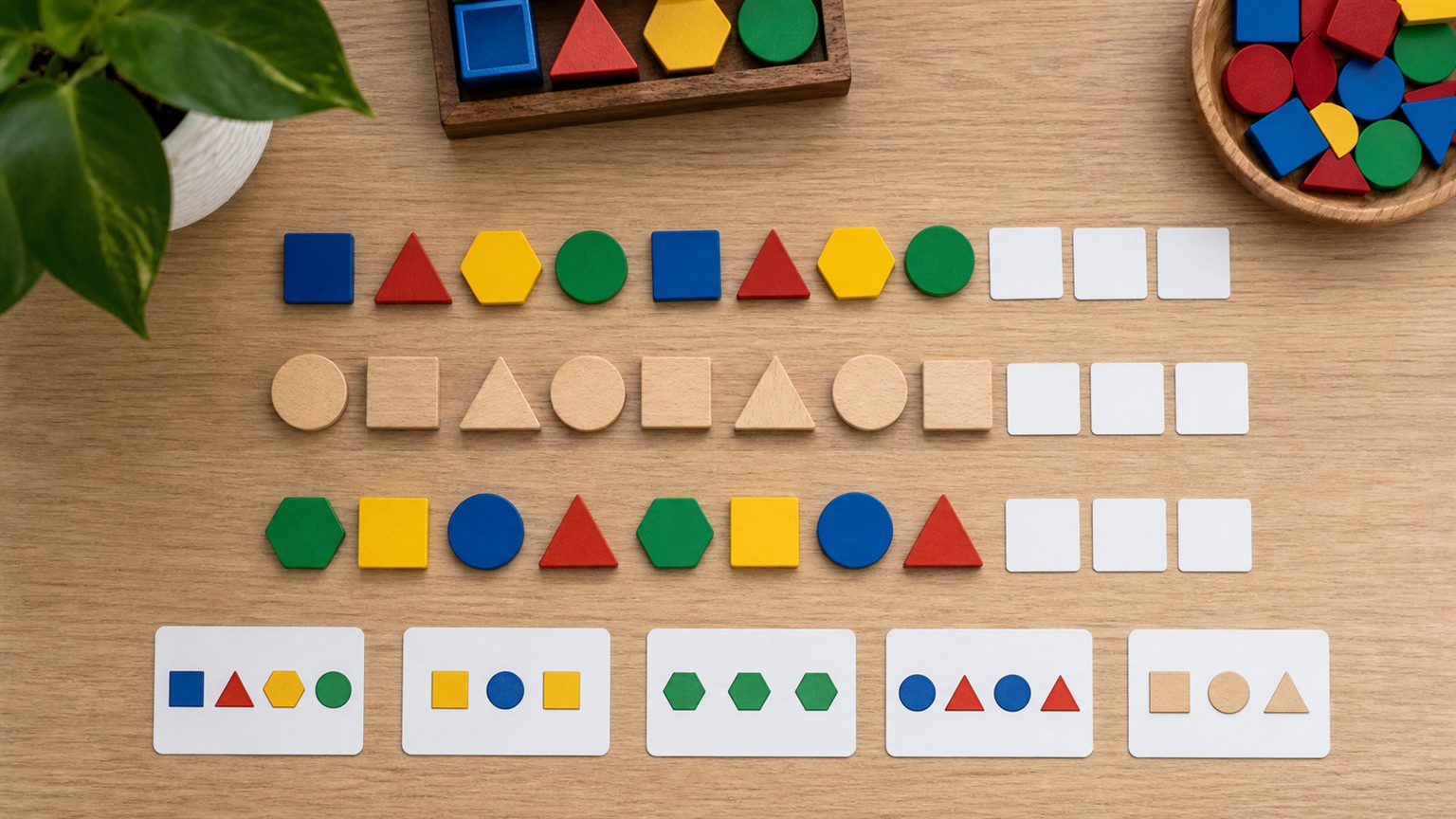
Alternating sequences are a common trap. A row may look inconsistent because it is actually two rows woven together. The first, third, and fifth items follow one rule, while the second, fourth, and sixth follow another. Once separated, the pattern becomes cleaner.
This idea applies beyond numbers. Shapes can alternate between two movement paths. Colors can cycle while sizes grow. Positions can jump between corners and center spaces. When a pattern feels irregular, checking every other item is often a productive move.
Shape Matrices and Visual Logic
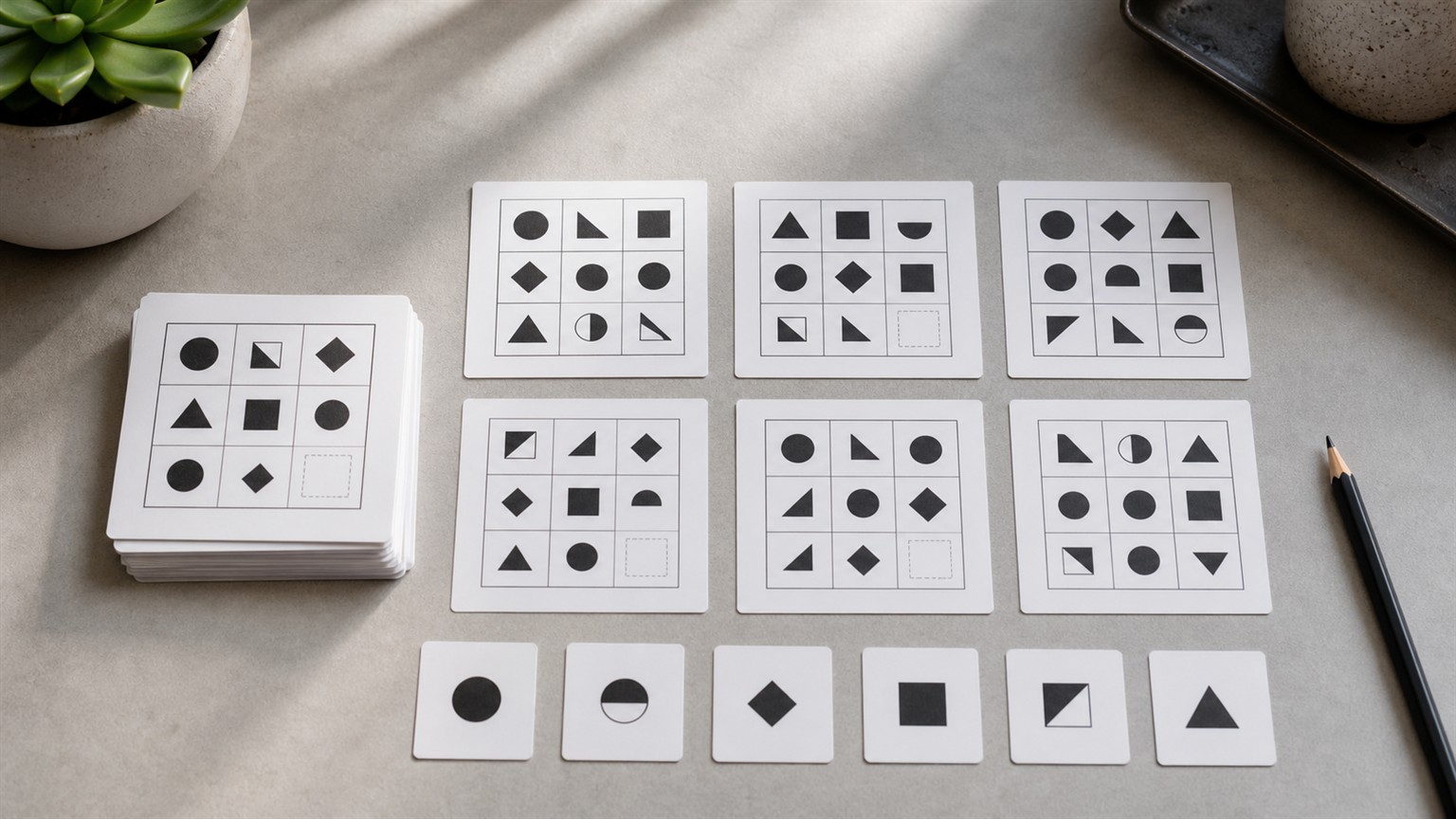
Matrix puzzles add a second dimension. Instead of reading only left to right, the solver compares rows, columns, and sometimes diagonals. One row may combine shapes. Another may remove shared parts. A column may rotate a figure. The missing cell must satisfy the strongest relationships around it.
Good matrix solving requires patience because several features compete for attention. Do not choose an answer because it matches one nearby cell. Ask how it behaves in the entire row and column. The right answer usually preserves a relationship, not just a resemblance.
Avoiding Overfitting
Overfitting happens when a solver invents a rule that technically fits the examples but feels too narrow or arbitrary. In recreational puzzles, the intended rule is usually elegant enough to explain the whole pattern with a small idea. If your rule needs a long paragraph, step back and look for something simpler.
Answer choices can make overfitting worse. A tempting option may fit one feature while violating another. Use choices for elimination, but do not let them replace rule discovery. First understand the pattern; then choose the answer that continues it.
Practice That Builds Pattern Skill
Pattern skill improves when you review solved examples. After finding an answer, name the rule family: rotation, alternation, count, position, reflection, or combination. This builds a mental library. The next time a similar structure appears, recognition happens faster.
Practice across formats matters too. Number sequences train change over time. Shape rows train visual comparison. Matrices train multi-directional reasoning. Odd-one-out puzzles train exception detection. Together, these formats make pattern recognition more flexible.
Training Yourself to Compare Deliberately
The core habit in pattern puzzles is deliberate comparison. Instead of asking what the answer might be, compare item one to item two, item two to item three, and then every other item if needed. In a grid, compare rows, columns, and diagonals. In a shape puzzle, compare outline, fill, count, position, and rotation separately. This slows the first impulse but speeds the actual solve.
Deliberate comparison prevents feature blindness. A solver may notice color immediately and miss that the number of corners is changing. Another may count shapes and miss a consistent rotation. By naming features one at a time, you give each possible rule a fair chance before committing.
Why Simple Rules Can Hide Well
Simple rules hide well when several features are changing at once. A triangle may rotate, change color, and move position across the same row. The solver sees motion everywhere and assumes the rule must be complicated. Often the puzzle is built from simple strands woven together. The task is to separate them.
This is why pattern puzzles reward note-like thinking even when no notes are written. Mentally label one feature as stable, one as changing, and one as irrelevant. If the outline rotates but color merely alternates, keep those ideas separate. The answer must satisfy the real structure, not the general impression of complexity.
Using Answer Choices Wisely
Answer choices can help, but they can also mislead. A choice may resemble the previous item closely while breaking the rule. Another may look less familiar but preserve the transformation. Use choices after you have a candidate rule. Then eliminate options that violate count, position, rotation, fill, or sequence.
If no rule is clear, choices can suggest which features matter. For example, if all choices have the same shape but different fills, fill is probably important. If choices vary by rotation, orientation may matter. This is useful, but it should support rule discovery rather than replace it.
Patterns Beyond Puzzle Pages
Pattern recognition puzzles are recreational, but the skill is broader. People use pattern recognition when reading charts, noticing habits, debugging processes, learning music, navigating spaces, and understanding stories. The puzzle version compresses the skill into a clean little problem, but the underlying habit is everyday reasoning.
This broader connection makes practice more rewarding. You are not only learning to solve rows of shapes. You are learning to ask better questions about change: What repeats? What shifts? What stays constant? What is missing? What rule would explain the whole set? Those questions travel well.
When to Stop and Reset
Sometimes a pattern puzzle stalls because the solver has become attached to the wrong feature. When that happens, reset deliberately. Cover the answer choices. Describe only what is visible. Change the direction of reading. Compare columns instead of rows. Count something you ignored. A reset is not giving up; it is changing the lens.
This habit is especially useful under pressure. The mind can loop on one bad rule and waste time defending it. A reset breaks the loop. Even if the next attempt does not solve the puzzle immediately, it usually reveals a feature that was previously invisible.
Building a Rule Vocabulary
Pattern puzzles become easier when you have names for common rules. Rotation, reflection, alternation, progression, repetition, overlay, subtraction, symmetry, and classification are not just labels. They are search tools. When a puzzle begins, these words remind you what kinds of relationships might be present.
A rule vocabulary also helps after solving. Instead of saying only that the answer was obvious, name why it worked. The shape rotated clockwise. The number of sides increased. The shaded region alternated. The third cell combined the first two. Naming the mechanism makes future recognition faster.
Using Wrong Answers Productively
Wrong answers can teach pattern recognition if you inspect them. Ask which feature pulled you toward the wrong choice. Did it match color but miss position? Did it continue the count but ignore rotation? Did it look symmetrical while breaking the sequence? Each wrong answer reveals which feature captured too much of your attention.
This review is especially helpful because pattern puzzles often include attractive distractors. Learning why a distractor is wrong trains discrimination. You begin to see not only the rule, but also the difference between a partial match and a complete continuation.
Teaching Pattern Thinking to Beginners
When teaching pattern puzzles, ask learners what they notice before asking for the answer. This keeps the focus on observation rather than performance. A beginner may say the shape gets bigger, the color repeats, or the object moves corners. Each observation is a possible doorway into the rule.
Encourage learners to test one idea across the whole pattern. If the idea explains only one step, revise it. This teaches flexible reasoning. The goal is not to guess quickly but to build an explanation strong enough to survive every item shown.
Mixed Patterns Need Separate Tracks
Many harder puzzles use mixed patterns. One feature may rotate while another alternates color and a third changes count. Solvers get lost when they try to merge those tracks too early. Separate them first. Ask what the shape does, what the fill does, what the position does, and what the number of parts does.
Once the tracks are clear, the answer often becomes straightforward. It must continue each track at the same time. This is why organized observation beats raw intuition in mixed patterns.
Why Elegance Matters
A good pattern rule usually feels elegant after discovery. It explains the items without unnecessary exceptions. It may be clever, but it should not feel arbitrary. Elegance is not a formal proof, yet it is a useful solving clue. If a proposed rule feels clumsy, keep looking.
This sense of elegance grows with practice. The more patterns you solve, the more you can distinguish a real rule from a forced explanation. That judgment is one of the quiet skills pattern puzzles build. It also makes solving more satisfying, because the final answer feels earned by understanding rather than lucky selection.
Conclusion: Look for the Rule Behind the Surface
Pattern recognition puzzles become easier when you stop asking what the answer looks like and start asking what rule the puzzle is using. Track features, test simple rule families, watch for alternation, compare rows and columns, and avoid explanations that fit only part of the evidence.
The reward is a specific kind of clarity. A row of shapes or numbers that seemed random suddenly has logic. Once you see the rule, the next step feels natural. That moment is why pattern puzzles remain so satisfying: they turn careful looking into understanding.