Solving by Proving What Must Be True
Deduction puzzles are built on evidence. They ask you to move from clues to conclusions without guessing, using each fact to narrow what can and cannot be true. The format can be a logic grid, a mystery, a seating chart, a scheduling problem, or a compact brain teaser, but the heart is the same: every correct answer must be justified. That is what makes deduction satisfying. You are not hoping your way forward. You are building a chain of reasons until the puzzle has only one place left to go.
A: Identify the goal, list the given information, and look for the clearest constraint.
A: Testing is useful; unsupported guessing is usually less helpful than narrowing possibilities.
A: Use one after you have tried several fair approaches and no longer have a testable idea.
A: The answer should make earlier clues feel purposeful once explained.
A: Change methods: sort, draw, reread, explain aloud, or step away briefly.
A: Not always. The best puzzle is the one whose difficulty fits the solver and setting.
A: Teams combine observation, memory, organization, and different puzzle habits.
A: Clear goals, fair constraints, useful feedback, and an earned breakthrough.
A: They can practice specific skills, especially when the challenge is varied and sustained.
A: Notice which clues mattered, which assumptions failed, and which method helped most.
What Makes a Puzzle Deductive
A deduction puzzle gives the solver enough information to reach a conclusion through reasoning. That conclusion might be a matching grid, an order of events, a hidden culprit, a location, or a single missing fact. The defining feature is not the theme but the standard of proof. The answer should follow from the clues, not from preference, luck, or outside knowledge.
This makes deduction puzzles feel fair when they are well designed. The solver may struggle, but the struggle happens inside a closed system. Every clue has a job. Every exclusion matters. When the solution arrives, it should feel inevitable in hindsight because the evidence was present all along.
Facts, Possibilities, and Tests
The most important habit is separating facts from possibilities. A fact is proven by the puzzle. A possibility is merely still alive. A test is a temporary path you are exploring because evidence has not yet forced a choice. Mixing these three creates confusion, especially in puzzles with several categories.
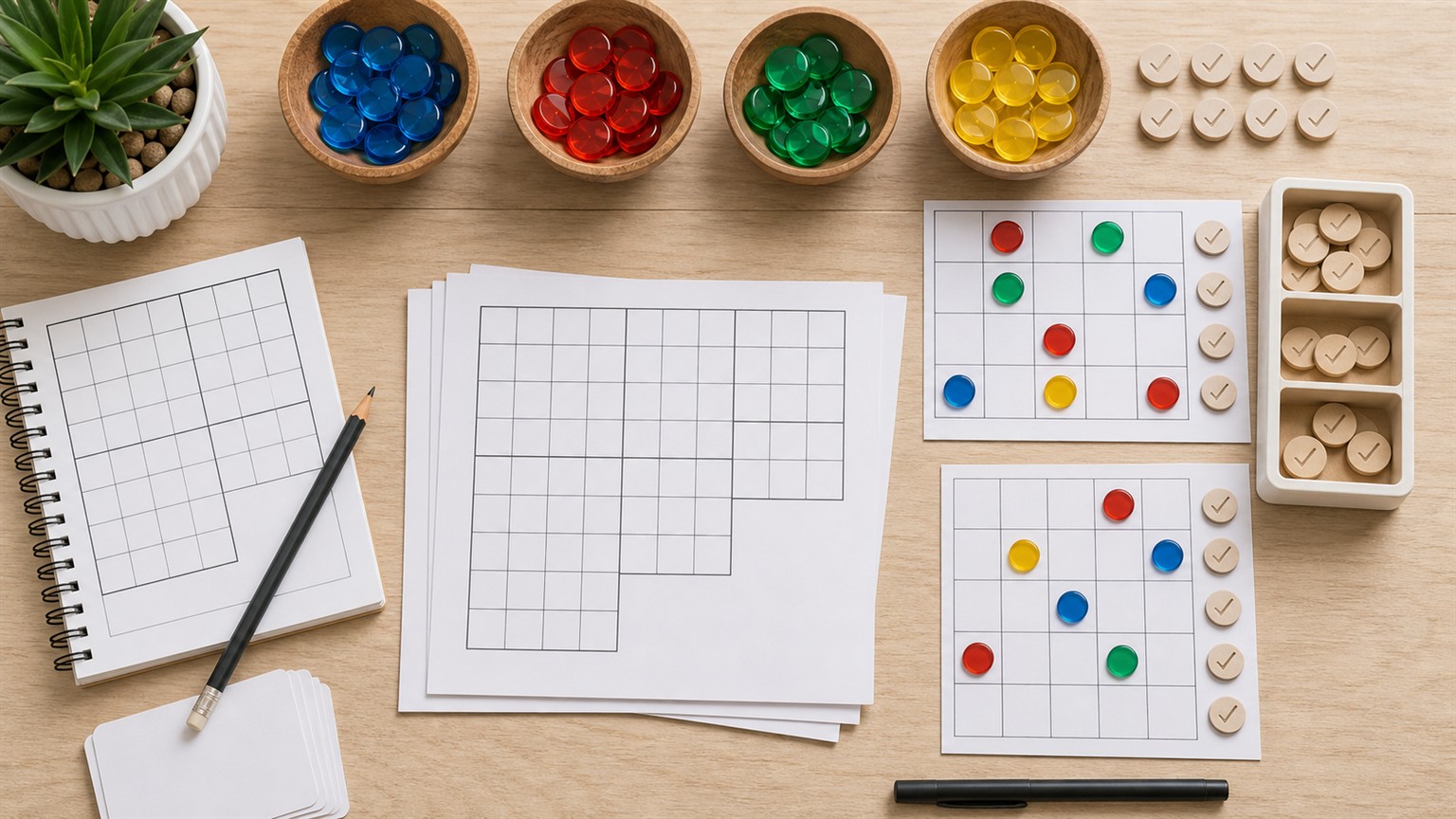
A clean solver marks them differently. Confirmed facts get firm placement. Eliminated options get a clear cross. Tests stay in side notes or light pencil. This discipline may feel slow at first, but it prevents one hunch from spreading through the whole puzzle.
How Elimination Creates Answers
Many deduction puzzles are solved less by finding the answer directly and more by removing everything else. If four possibilities are impossible, the fifth becomes true. That kind of conclusion can feel almost too simple, but it is the engine of the genre. A negative clue may be just as powerful as a positive one.
After each elimination, look for consequences. A removed option may leave a row with one opening, which confirms a match, which removes that match from other rows. Deduction puzzles often advance through cascades. The solver's job is to notice when a small mark changes the larger system.
Reading Clues With Precision
Deduction clues are precise even when they are written casually. Words such as before, after, between, exactly, neither, only, beside, and different can determine the entire solve. Read slowly enough to preserve those distinctions. If a sentence feels tangled, rewrite it as a simpler statement before using it.
Precision also means respecting what a clue does not say. If a clue says one event happened before another, it does not prove they were adjacent. If it says two people chose different objects, it does not say which object either person chose. Strong solvers protect these boundaries.
Using Contradictions Well
A contradiction is useful information. It tells you the current set of marks cannot all be true. Instead of pushing forward, stop and inspect the path that created the conflict. Recent deductions are the best place to begin, but older copied marks and misread clues can also be responsible.
The emotional skill is staying calm. A contradiction does not mean you are bad at the puzzle. It means the puzzle has found an inconsistency for you. Work backward, identify the fragile assumption, and repair the chain.
Solving Mysteries and Story Deduction
Some deduction puzzles hide their structure inside a story. A short mystery may include motives, times, objects, and statements rather than a visible grid. The same principles still apply. Identify categories, separate claims from facts, and ask what each detail rules out.
Story deduction can be especially tricky because atmosphere encourages assumptions. A suspicious detail may be misdirection, while a plain sentence may contain the crucial constraint. Treat the story as evidence, not decoration, and the puzzle becomes more manageable.
Practice That Builds Deductive Skill
To improve, review your solved puzzles. Ask which clue opened the solve, which clue you underused, and where you almost guessed. This review turns one finished puzzle into a lesson for the next. You begin to recognize clue shapes and common traps.
It also helps to solve varied formats. Logic grids teach systematic marking. Seating puzzles teach position. Mystery puzzles teach evidence reading. Scheduling puzzles teach ordering. Together, they build a broader deductive toolkit.
Why Deduction Feels So Clean
Deduction feels clean because the solver is not trying to impress the puzzle with cleverness. The solver is trying to obey the evidence. That shift changes the mood. Instead of asking what answer sounds plausible, you ask what answer remains after the clues have done their work. A well-built deduction puzzle gives the mind a narrow bridge from confusion to certainty.
This is also why deduction puzzles can be relaxing despite being difficult. They create a world where facts matter, contradictions are useful, and careful thinking is rewarded. The solver may take wrong turns, but the puzzle keeps offering ways to repair them. The answer is not a matter of taste. It is a matter of fit.
Choosing the Right Deduction Format
Different deduction formats train different habits. Logic grids are best for category matching. Seating and scheduling puzzles train order and adjacency. Mystery puzzles train evidence reading and motive analysis. Statement puzzles train consistency checking. Choosing the right format depends on what kind of reasoning you want to practice.
Beginners usually benefit from visible structure. A grid, table, or simple ordered list gives the clues somewhere to land. Once the basic habits feel comfortable, story-based deduction becomes easier because you can mentally create the missing structure yourself.
How to Explain a Deductive Answer
A strong answer can be explained. If you cannot say why a conclusion must be true, it may still be a guess wearing a confident face. Practice explaining the final chain: this clue removed one option, that clue fixed a position, and the remaining possibility forced the answer. Explanation strengthens the solve.
This habit is especially useful in groups. When solvers explain deductions aloud, everyone can check the reasoning and catch weak assumptions. The discussion becomes more than a race to the answer. It becomes a shared proof.
When Deduction Becomes Everyday Thinking
Deduction puzzles are recreational, but their habits travel. Separating fact from assumption, noticing contradictions, and checking conclusions against evidence are useful beyond puzzle pages. They help in planning, troubleshooting, reading, and decision-making.
The point is not to turn everyday life into a grid. The point is to practice a disciplined kind of curiosity. Deduction puzzles make that discipline enjoyable because they give it a clear finish and a satisfying reward.
The Difference Between Deduction and Guessing
Guessing begins with a possible answer and looks for support afterward. Deduction begins with support and lets the answer emerge. That distinction matters because a guessed answer can feel convincing long before it is proven. A deduction puzzle rewards the solver who waits for the clues to create pressure from several directions.
This does not mean intuition has no place. A hunch can point your attention toward a useful clue or suspicious category. The mistake is writing the hunch as fact before it survives testing. Treat intuition as a flashlight, not as a verdict.
Using Small Proofs Throughout the Puzzle
A deduction puzzle is rarely solved by one grand leap. It is solved by many small proofs. One clue proves that a person cannot be in one position. Another proves that an object must belong in a certain group. A third connects those facts into a new conclusion. The solve grows in layers.
When you get stuck, look for the smallest proof available. Do not demand the final answer immediately. Ask what can be known now, even if it seems minor. Small proofs are the stepping stones that make larger deductions possible.
Why Review Makes You Better
After solving, review the path. Find the clue that did the most work, the clue you ignored too long, and the moment when the puzzle shifted. This review is short, but it teaches you how deduction feels when it is working.
Without review, every puzzle becomes isolated. With review, patterns accumulate. You begin recognizing when a clue is restrictive, when a negative statement is powerful, and when a contradiction is actually useful feedback.
Choosing When to Test a Possibility
Testing a possibility is useful when the puzzle has narrowed to a genuine fork. The key is to label the test clearly. Follow one branch and watch whether it creates a contradiction or confirms a chain. If the branch fails, remove it completely. If it succeeds, audit it before treating it as solved.
This is different from guessing because the test is controlled. You are not hoping the answer works. You are exploring consequences. The test should teach you something either way.
The Satisfaction of a Proven Answer
A proven answer feels different from a lucky answer. It carries the weight of the clues behind it. You can point to the path that led there, and that path makes the solution stable. This is the pleasure that keeps deduction puzzles compelling.
Even when the subject matter is playful, the mental reward is serious. The solver experiences the relief of uncertainty becoming certainty. That transformation is small, clean, and deeply satisfying.
Common Deduction Puzzle Themes
Deduction puzzles can wear many costumes. Some look like detective stories, some look like dinner seating charts, and some look like classroom matching problems. The theme changes the flavor, but the reasoning stays familiar. You are still matching claims to facts, removing impossible options, and watching for contradictions.
Themes matter because they affect attention. A mystery theme may make solvers look for motive. A schedule theme may make them look for order. A household-object theme may make the same logic feel gentler. Choosing themes you enjoy can make practice feel much less mechanical.
How Difficulty Increases
Difficulty usually increases through more categories, more indirect clues, and more delayed consequences. A beginner puzzle may give several direct matches. A harder puzzle may give mostly comparisons, negatives, and conditions that become useful only after other marks are made.
Understanding this helps you choose the right challenge. If a puzzle feels impossible, it may not require a smarter solver; it may require a smaller version of the same skill. Step down, practice the clue type that caused trouble, and return later.
Conclusion: Let Evidence Do the Work
Deduction puzzles are satisfying because they reward disciplined curiosity. You gather facts, remove impossibilities, follow consequences, and test uncertain paths carefully. The final answer feels good because it has been earned by evidence.
The best way to solve them is simple to state and rich to practice: read precisely, mark cleanly, separate fact from possibility, respect negative clues, and audit the answer. Do that, and deduction puzzles become less like guessing games and more like conversations with proof.