Training the Mind to See Structure
Visual and spatial puzzles train a different kind of thinking than word or number puzzles. They ask you to rotate shapes in your mind, notice edges and gaps, track routes, compare patterns, and imagine how pieces might fit before your hands prove it. These puzzles can be quiet and meditative, like a jigsaw on a table, or intensely strategic, like a packing puzzle with one impossible-looking solution. The best visual and spatial puzzles strengthen attention because they make thinking visible. You are not only looking at objects. You are learning how space behaves.
A: Identify the goal, list the given information, and look for the clearest constraint.
A: Testing is useful; unsupported guessing is usually less helpful than narrowing possibilities.
A: Use one after you have tried several fair approaches and no longer have a testable idea.
A: The answer should make earlier clues feel purposeful once explained.
A: Change methods: sort, draw, reread, explain aloud, or step away briefly.
A: Not always. The best puzzle is the one whose difficulty fits the solver and setting.
A: Teams combine observation, memory, organization, and different puzzle habits.
A: Clear goals, fair constraints, useful feedback, and an earned breakthrough.
A: They can practice specific skills, especially when the challenge is varied and sustained.
A: Notice which clues mattered, which assumptions failed, and which method helped most.
Why Spatial Reasoning Feels Different
Spatial reasoning is the ability to understand where things are, how they relate, and how they might change when moved. It is the thinking behind reading a map, packing a suitcase, assembling furniture, navigating a maze, or imagining a shape from another angle. Visual and spatial puzzles isolate those skills in a playful form.
Unlike many word puzzles, spatial puzzles often give feedback through the hands and eyes. A piece fits or it does not. A route reaches the exit or loops back. A shape balances or leaves a gap. That direct feedback makes the learning process satisfying, even when the solution takes time.
Jigsaws, Tangrams, and Tiling Puzzles
Jigsaw puzzles are the familiar classic, and they remain excellent training tools. Solvers learn to compare edges, colors, textures, and tiny shape differences. Larger jigsaws also build patience and organization because the best path usually involves sorting before assembling.
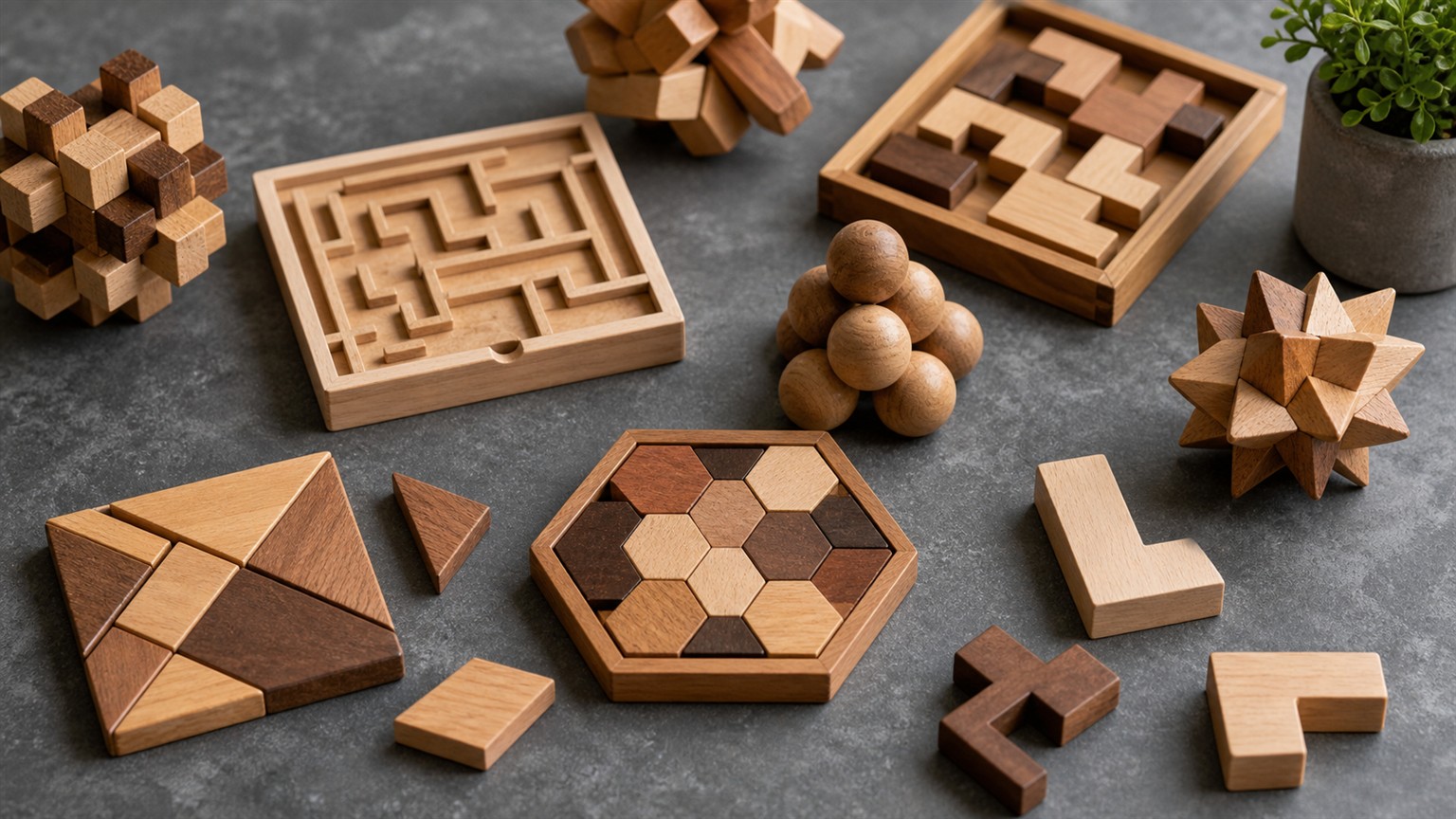
Tangrams and tiling puzzles teach a more abstract skill. A few simple shapes can create many forms, but only when orientation and proportion are understood. Pentominoes and packing puzzles go further by asking solvers to fill a space completely. The empty gaps become as important as the pieces.
These puzzles are especially good for learning that visual problem solving is not random. Strong solvers test possibilities, notice constraints, and change strategy when a section stops progressing.
Mazes and Route Planning
Mazes train the eye to follow paths, anticipate dead ends, and hold a route in memory. A simple paper maze may look childish, but complex mazes can be serious spatial challenges. The solver must balance local choices with the larger structure of the path.
Hidden Objects and Visual Search
Hidden-object and spot-the-difference puzzles emphasize attention. They train solvers to scan systematically instead of bouncing randomly around the image. The challenge is not moving pieces but controlling the eye. You learn to compare regions, track what has already been checked, and notice small disruptions in pattern.
These puzzles can be relaxing, but they also reveal how easily the brain fills in expected details. A missing stripe, changed shadow, or camouflaged object may remain invisible until the search strategy changes. That makes visual search puzzles useful for practicing patience and flexible attention.
Three-Dimensional Challenges
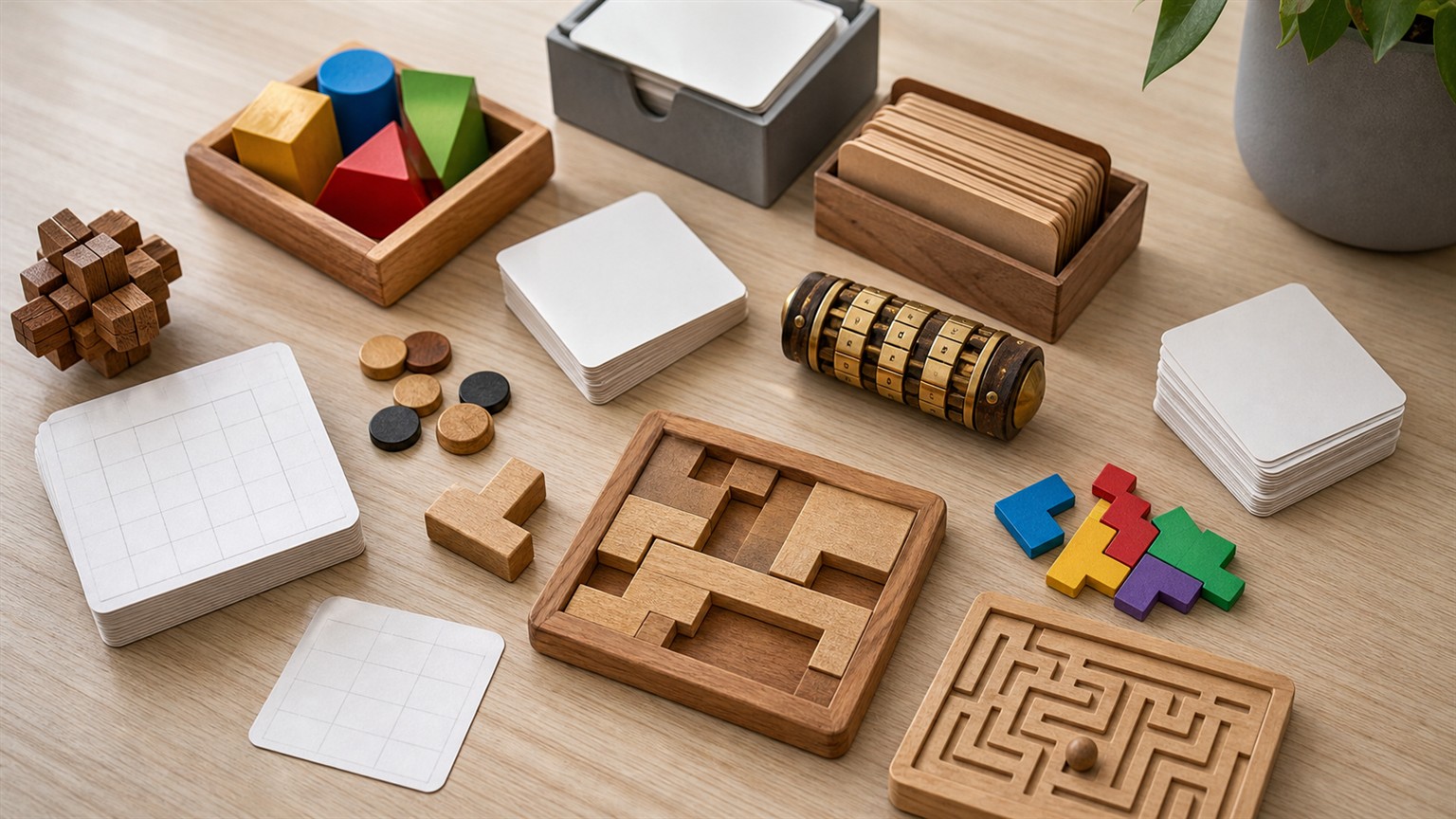
3D puzzles add depth, orientation, and sequence. A burr puzzle may require pieces to move in a particular order. A puzzle box may hide a mechanism that can be opened only after several spatial discoveries. A Soma cube may ask the solver to build a larger form from smaller irregular pieces.
These puzzles are valuable because they force mental rotation. Before moving a piece, you imagine how it might turn, slide, or nest inside another shape. That imagined movement is the skill. The physical object simply tells you whether the mental model was accurate.
Beginners should start with simpler 3D challenges. Too many hidden constraints can make the puzzle feel opaque. As skill grows, the delayed reveal becomes part of the pleasure.
How to Practice Seeing Better
The best spatial practice begins with slowing down. Look at the boundary. Look at the pieces. Look at the gaps. Many solvers focus only on what they are holding and ignore the negative space where the piece must fit. Training your attention to include empty space is one of the fastest ways to improve.
Choosing Puzzles for Mind Training
If your goal is calm focus, choose jigsaws, hidden-object puzzles, or visual comparison games. If your goal is mental rotation, choose tangrams, packing puzzles, Soma cubes, or mechanical assemblies. If your goal is planning, choose mazes, sliding tiles, and sequential movement puzzles.
A balanced spatial puzzle habit includes several formats. Flat puzzles teach pattern and edge recognition. 3D puzzles teach rotation and assembly. Search puzzles teach attention. Route puzzles teach planning. Together they create a broader visual toolkit.
Training Mental Rotation and Negative Space
Mental rotation is one of the signature skills in spatial puzzles. It is the ability to imagine a piece turned, flipped, or shifted before actually moving it. Tangrams, packing puzzles, Soma cubes, and interlocking mechanical puzzles all ask for this skill. At first, solvers may need to physically try every orientation. With practice, the mind begins testing some of those turns internally, which makes solving smoother and more deliberate.
Negative space is just as important. In a jigsaw, the gap between pieces may reveal the needed shape before the piece itself is found. In a packing puzzle, the leftover hole tells you whether the current arrangement can possibly work. In a maze, blocked routes define the path as much as open corridors do. Spatial thinking improves when you learn to study absence as information.
These skills matter beyond puzzles. They appear in organizing a room, reading diagrams, loading a car, following assembly instructions, and navigating unfamiliar places. Visual puzzles are enjoyable because they make those everyday spatial decisions smaller, clearer, and safer to practice.
Designing a Spatial Puzzle Practice Habit
A strong spatial practice habit alternates between calm observation and active manipulation. One session might be a jigsaw where the goal is patient sorting. Another might be a tangram where the goal is rapid experimentation. Another might be a 3D puzzle where the goal is to think before touching the pieces. Each format trains a slightly different relationship between eye, hand, and imagination.
Keep sessions short enough that attention stays sharp. Spatial fatigue is real; after a while, pieces begin to look alike and routes blur together. A short break can restore perception more effectively than forcing another twenty minutes. When you return, rotate the puzzle, change the viewing angle, or sort the pieces again. A new view often creates the breakthrough that effort alone could not.
Choosing Between Flat, Physical, and Search-Based Puzzles
Flat puzzles are excellent for learning pattern, outline, and surface relationships. Jigsaws, tangrams, mazes, and visual matrices keep the problem visible on one plane. They are approachable because the solver can see nearly all the information at once. That makes them useful for beginners, classrooms, and anyone who wants spatial practice without complicated mechanics.
Physical puzzles add another layer because the object must be handled. A piece may look right but fail to slide into place. A cube may need to rotate before it nests correctly. A puzzle box may require a sequence of discoveries before the next movement is possible. These puzzles train patience with materials as much as imagination. They also make mistakes tactile, which can be useful for learning.
Search-based puzzles such as hidden objects and spot-the-difference challenges train attention rather than assembly. They are ideal when the goal is careful looking. Because all three families build different skills, the best spatial training plan does not crown one winner. It rotates among them so the mind practices seeing, imagining, and testing in several ways.
Measuring Spatial Improvement
Spatial improvement often feels subtle because it shows up as smoother seeing rather than a single new fact. You may sort jigsaw pieces more effectively, rotate tangram shapes mentally before touching them, notice maze dead ends earlier, or recognize that a packing arrangement cannot work before the final piece fails. These moments are signs that the mind is building better internal models.
To notice progress, repeat a format occasionally. Solve a similar tangram set after a few weeks, revisit a maze style, or try another small 3D assembly. The puzzle does not have to be identical. It only needs to ask for the same kind of seeing. If the second experience feels calmer, more organized, or less dependent on random trial, your spatial reasoning is growing.
Avoiding Visual Overload
Visual puzzles can overwhelm the eye when too much information arrives at once. A thousand jigsaw pieces, a crowded hidden-object scene, or a complex 3D assembly can make the solver feel as if nothing stands out. The answer is not always to try harder. Often the answer is to reduce the field. Sort by edge, color, shape, texture, or function. Create smaller problems inside the larger one.
Changing viewpoint also helps. Stand up, rotate the board, move a lamp, or look at the puzzle from farther away. Spatial insight is sensitive to perspective. A pattern that disappears from one angle may become obvious from another. Learning to manage overload is part of spatial training because it teaches the solver to control attention rather than be controlled by the scene.
Keeping Spatial Puzzles Enjoyable
Spatial puzzles are most useful when they remain playful. If a puzzle becomes pure frustration, change the conditions before quitting entirely. Sort a smaller area, invite another person to look, switch from a 3D challenge to a flat one, or take a break and return with fresh eyes. The goal is not to overpower the puzzle. The goal is to keep perception flexible.
Enjoyment also improves attention. A solver who feels curious will notice more than a solver who feels cornered. Choose materials, themes, and difficulty levels that make you want to look again. That repeated looking is where spatial training quietly does its work. It is also why variety matters. A solver who alternates jigsaws, tangrams, mazes, and three-dimensional assemblies gives the mind several ways to practice space without turning one format into a grind.
Spatial confidence often grows when solvers notice their own process. You may begin by sorting more deliberately, checking the boundary before the center, or rotating a piece in your head before testing it by hand. These process changes matter. They show that the puzzle is training perception, not merely occupying time. Over time, that sharper perception can make everyday spatial tasks feel more organized too, from packing a drawer to reading a diagram with less effort. The skill grows quietly, but it shows up in how calmly you approach the next shape, gap, route, or object. That calm attention is the real training effect over time.
Conclusion: Spatial Skill Grows Through Looking
Visual and spatial puzzles train the mind by asking it to look more carefully than usual. They reveal structure in shapes, routes, gaps, and movement. The improvement may feel subtle at first, but over time solvers begin to see possibilities faster and mistakes earlier.
The best puzzle is the one that makes you curious enough to keep looking. Whether you choose a jigsaw, tangram, maze, packing challenge, or 3D mechanical puzzle, the real exercise is the same: notice relationships, test them patiently, and let space teach you how it works.