The Big Question Behind Brain Training
Transfer is the big question behind brain training. If you practice a puzzle, do you only get better at that puzzle, or do the skills generalize to other tasks? The answer depends on how similar the tasks are, what skill is being practiced, how progress is measured, and how ambitious the claim is. Puzzle skills often generalize within nearby formats: a solver may move from easy Sudoku to harder Sudoku, or from one logic grid to another. Far transfer to everyday cognition is much harder to prove and should be described with caution.
A: They often generalize best to similar puzzles and strategies, while broad everyday transfer is harder to prove.
A: Improvement on tasks closely related to the practiced task.
A: Improvement on different tasks or real-world outcomes beyond the practice setting.
A: It may help related constraint habits, but broad reasoning gains need careful evidence.
A: Often yes; named strategies can be applied more deliberately across formats.
A: Practice varied examples, review strategies, and test them in related puzzle types.
A: Far transfer sounds more exciting and marketable than task-specific improvement.
A: Explaining strategies in groups may make them easier to reuse.
A: Track whether a specific strategy helps in a new but related puzzle.
A: Puzzle practice can build reusable strategies, especially near the trained domain.
Near Transfer Is the Strongest Starting Point
Near transfer is easiest to understand. A person who practices easy logic grids may become better at harder logic grids. A crossword solver may become better at similar clue conventions. The tasks share enough structure that learning can travel.
This kind of transfer is still useful. It explains how solvers grow within a puzzle family. Not every benefit has to leap into unrelated life tasks to be worthwhile.
Far Transfer Needs Stronger Evidence
Far transfer is the ambitious claim. It suggests that training one task improves quite different abilities or everyday functioning. This is harder to prove because many other factors influence daily performance.
A study has to measure far transfer directly. It is not enough to show that a person improved at the training puzzle and assume the rest.
Strategies May Travel Better Than Scores
A score is tied to a task. A strategy can be named and reused. For example, separating facts from assumptions can help in logic grids, riddles, workplace decisions, and classroom problem solving, but the transfer is more plausible when the person consciously recognizes the strategy.
This is why review matters. After solving, ask what method helped. The method is more likely to travel when it has a name.
Surface Similarity Can Mislead
Two puzzles may look similar while using different skills, or look different while sharing a deeper structure. A word puzzle and a visual puzzle might both require pattern recognition. Two app games might look different but train the same quick response.
Evaluating transfer requires looking beneath the surface. What is the solver actually practicing?
Puzzle Variety and Generalization
Variety can encourage generalization within the puzzle world. If a solver practices only one exact format, they may learn that format narrowly. If they practice several formats that share a skill, they may learn the underlying habit more flexibly.
For example, elimination appears in logic grids, scheduling puzzles, mystery puzzles, and some escape-room tasks. Seeing elimination in several contexts helps the solver recognize it as a strategy.
Why Everyday Transfer Is Hard to Measure
Everyday life is noisy. Sleep, stress, motivation, environment, knowledge, health, and social context all affect performance. Showing that puzzle practice changed daily functioning requires careful study design.
This does not mean everyday transfer never happens. It means strong claims need strong evidence.
How Solvers Can Test Their Own Transfer
A solver can run a modest personal test. Learn a strategy in one puzzle type, then deliberately apply it to a nearby format. Does it help? Does it need adjustment? What changed?
This personal evidence is not the same as scientific proof, but it is useful for building a better routine. It keeps transfer specific and observable.
The Role of Teaching
Teaching a strategy to someone else may support transfer. Explanation forces the solver to separate the method from the original puzzle. Once the method is abstracted, it becomes easier to recognize elsewhere.
This is one reason group solving can be valuable. People do not only exchange answers; they exchange portable ways of thinking.
Avoiding Transfer Hype
Transfer hype takes a small improvement and turns it into a sweeping promise. It may imply that any puzzle improves intelligence, productivity, or life success. That leap is not responsible.
A better approach celebrates real but bounded growth. Getting better at a puzzle family, strategy, or attention habit is meaningful. It does not need exaggerated claims to matter.
The Transfer Ladder
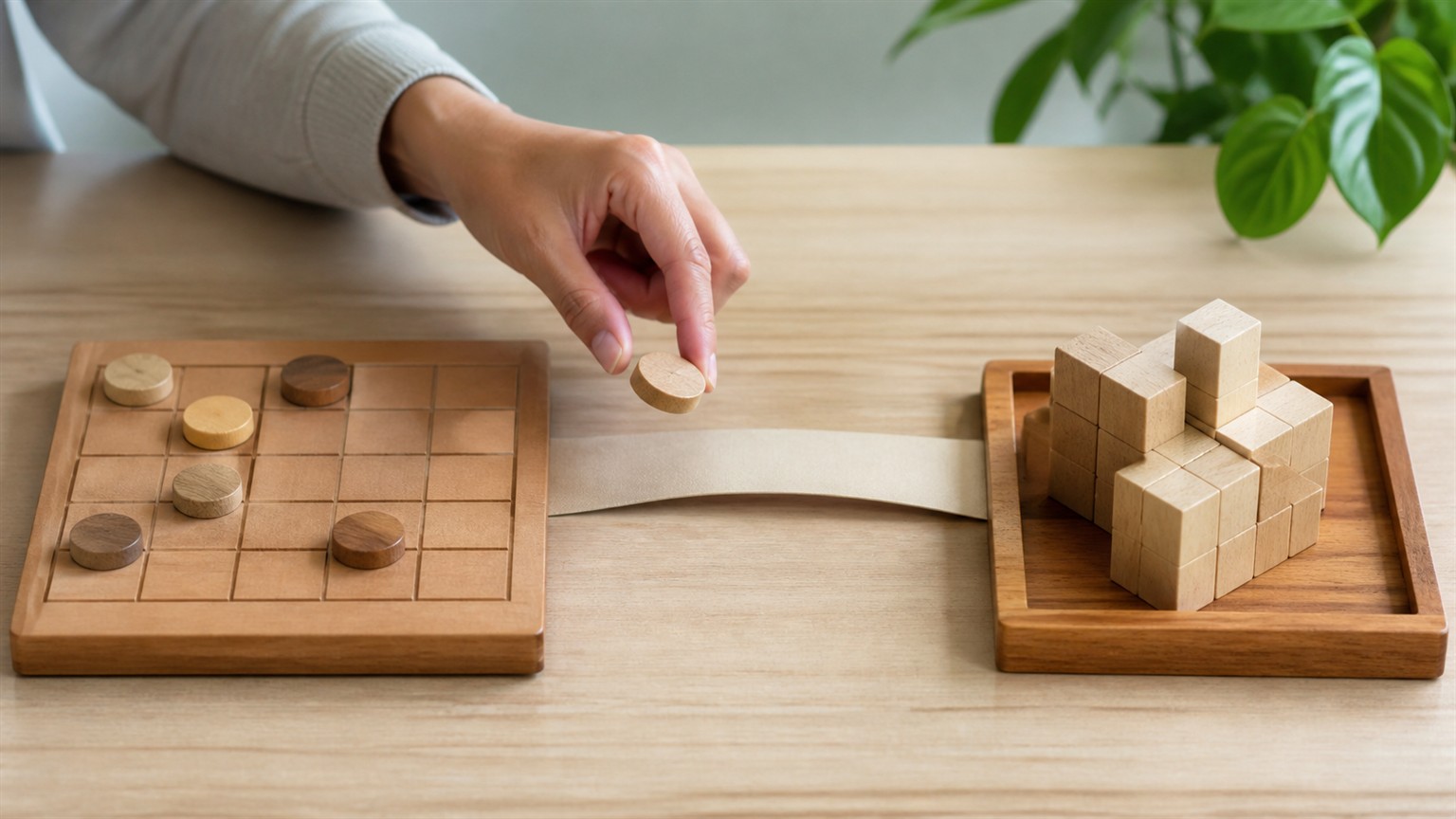
Transfer can be imagined as a ladder. The lowest rung is improvement on the exact trained task. The next rung is improvement on a similar task. Higher rungs include different puzzle formats, academic or work tasks, and everyday life. Each higher rung needs more evidence.
This ladder helps prevent overclaiming. A solver who gets better at Sudoku has clearly improved at Sudoku. They may also improve at related number-placement puzzles. Claiming broad life gains is a much higher rung.
The higher the rung, the more carefully the claim should be tested.
Why Strategy Naming Helps
A strategy is easier to transfer when it has a name. Elimination, grouping, edge sorting, rereading, contradiction checking, and candidate tracking are all strategies that can travel across puzzles. If a solver only remembers the finished answer, transfer is less likely.
Naming turns a tactic into a tool. The solver can recognize that a new puzzle is asking for the same tool in a different setting. This is why post-solve review matters.
Near Transfer Examples That Matter
Near transfer may sound modest, but it can be valuable. A crossword beginner who learns clue conventions gains access to harder grids. A jigsaw solver who learns sorting strategies can enjoy larger puzzles. A logic-grid solver who learns notation can tackle more complex stories.
These gains enrich the hobby. They also build confidence through real growth. The fact that they are near the trained domain does not make them trivial.
Why Far Transfer Is Tempting
Far transfer is tempting because it promises that a small practice will improve a large life area. That promise is emotionally appealing and commercially useful. It is also difficult to prove.
Everyday outcomes are influenced by many variables. Better focus at a puzzle table may help someone feel more organized, but proving that effect for a population requires careful measurement.
This is where cautious language protects readers.
Designing Practice for Better Generalization
To encourage generalization, practice should include variation around a shared skill. If the target skill is elimination, solve several types of elimination puzzles. If the target is visual comparison, use jigsaws, spot-the-difference tasks, and spatial puzzles.
Variation teaches the mind to recognize the underlying structure rather than memorizing one surface format. The solver learns what stays the same when the puzzle changes.
Tracking Transfer Honestly
An honest transfer log is specific. Instead of writing puzzles made me sharper, write the elimination notes from logic grids helped me organize a scheduling puzzle. Specificity makes the claim testable.
This kind of tracking is useful even when it is personal rather than scientific. It helps the solver build a routine that actually supports the skills they care about.
How Surface Features Trap Transfer
Surface features can trap transfer. A solver may think a strategy belongs only to Sudoku because that is where they learned it. In reality, the strategy may be candidate tracking, which can appear in logic grids, scheduling puzzles, and some deduction games.
To escape surface traps, name the deeper operation. Are you eliminating, grouping, sequencing, rotating, comparing, or testing contradiction? The deeper name makes reuse easier.
Transfer Requires Recognition
A strategy cannot transfer if the solver does not recognize when it applies. Recognition is the bridge between practice and reuse. The new task has to feel similar enough at the structural level for the solver to try the old tool.
This is why varied practice helps. It exposes the same underlying skill in several forms, making the structure easier to spot later.
Review strengthens recognition by asking what the puzzle was really about.
Why Some Skills Stay Narrow
Some skills stay narrow because they depend heavily on specific content or interface features. A person may improve at a particular app game by learning its timing and patterns, but those learned details may not appear elsewhere.
Narrow learning is not failure. It becomes a problem only when it is advertised as broad learning. A narrow gain can still be enjoyable, motivating, or useful within the chosen hobby.
Building Transfer Through Explanation
Explanation helps transfer because it strips away surface details. When a solver explains that they used elimination, not just that they solved row four, the method becomes portable. Teaching another person can make this even clearer.
This is one reason puzzle clubs and classrooms can be effective learning environments. People hear strategies named, questioned, and applied in new examples.
A Realistic Transfer Routine
A realistic transfer routine practices one skill across several nearby formats. For example, practice visual comparison with jigsaws, spot-the-difference puzzles, and tangrams. Practice deduction with logic grids, mystery puzzles, and seating arrangements.
After each session, write one sentence about the shared skill. That small step increases the chance that the skill becomes recognizable beyond the original puzzle.
The Role of Deliberate Variation
Deliberate variation is different from random variety. It means choosing several tasks that practice the same underlying skill in different ways. This gives the solver a better chance to recognize the skill when the surface changes.
For transfer, deliberate variation is more useful than constantly chasing novelty. It keeps the practice connected while still preventing narrow memorization.
Why Transfer Can Be Emotional Too
Transfer is usually discussed as a cognitive effect, but confidence can travel as well. A solver who learns that hard puzzles can be broken into smaller steps may approach a new challenge with less panic. That emotional shift is valuable, though it should be described separately from measured cognitive gain.
Clear categories help: strategy transfer, confidence, and task performance are related but not identical.
Teaching Transfer to Beginners
Beginners benefit when transfer is made explicit. After a puzzle, an adult, teacher, or group leader can ask where the same strategy might appear again. This turns a single solve into a portable lesson.
The question should stay concrete. Where else could elimination help? What other puzzle uses sorting? Which clues require rereading?
Transfer Is Not All-or-Nothing
Transfer is not all-or-nothing. A skill may transfer partly, within a narrow range, or only when the solver deliberately applies it. The question is not simply does it transfer, but how far, under what conditions, and for whom.
This more nuanced view is useful for puzzle practice. It lets solvers look for realistic bridges instead of expecting one puzzle habit to improve everything.
Why Reflection Extends the Radius
Reflection can extend the radius of transfer by making strategies visible. A solver who writes down used edge sorting, checked contradictions, or grouped clues by category is more likely to recognize the same move later.
The reflection does not need to be long. One clear sentence after solving can do more for transfer than finishing another puzzle without noticing the method.
Conclusion: Generalization Has a Radius
Puzzle skills can generalize, but the radius varies. The closer the new task is to the practiced skill, the more plausible the transfer. The farther the claim reaches, the more evidence it needs.
Solvers can support transfer by practicing varied examples, naming strategies, and testing them in related contexts. That is a grounded, useful way to grow.