Mechanical Puzzles Reward Slow Attention
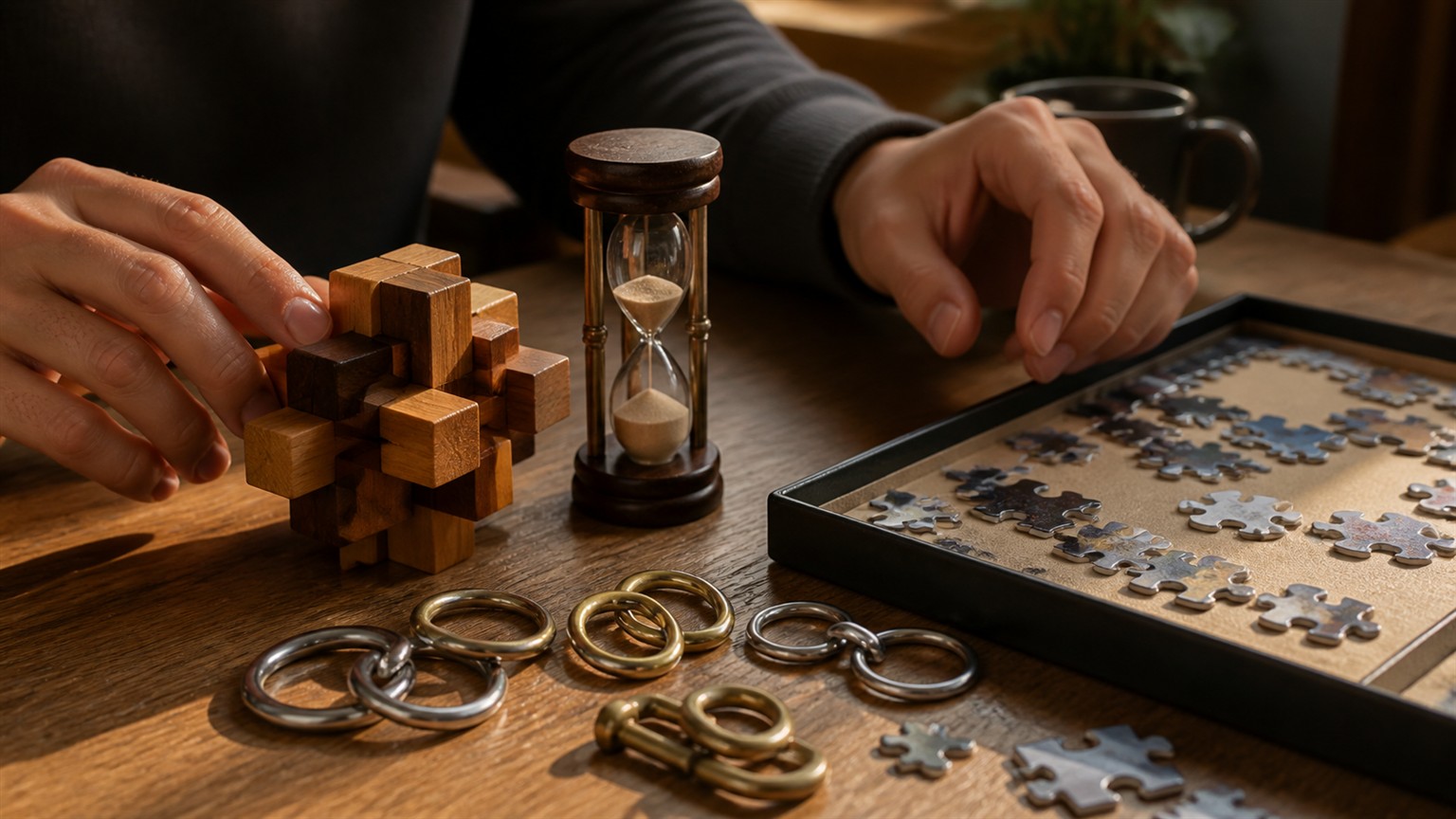
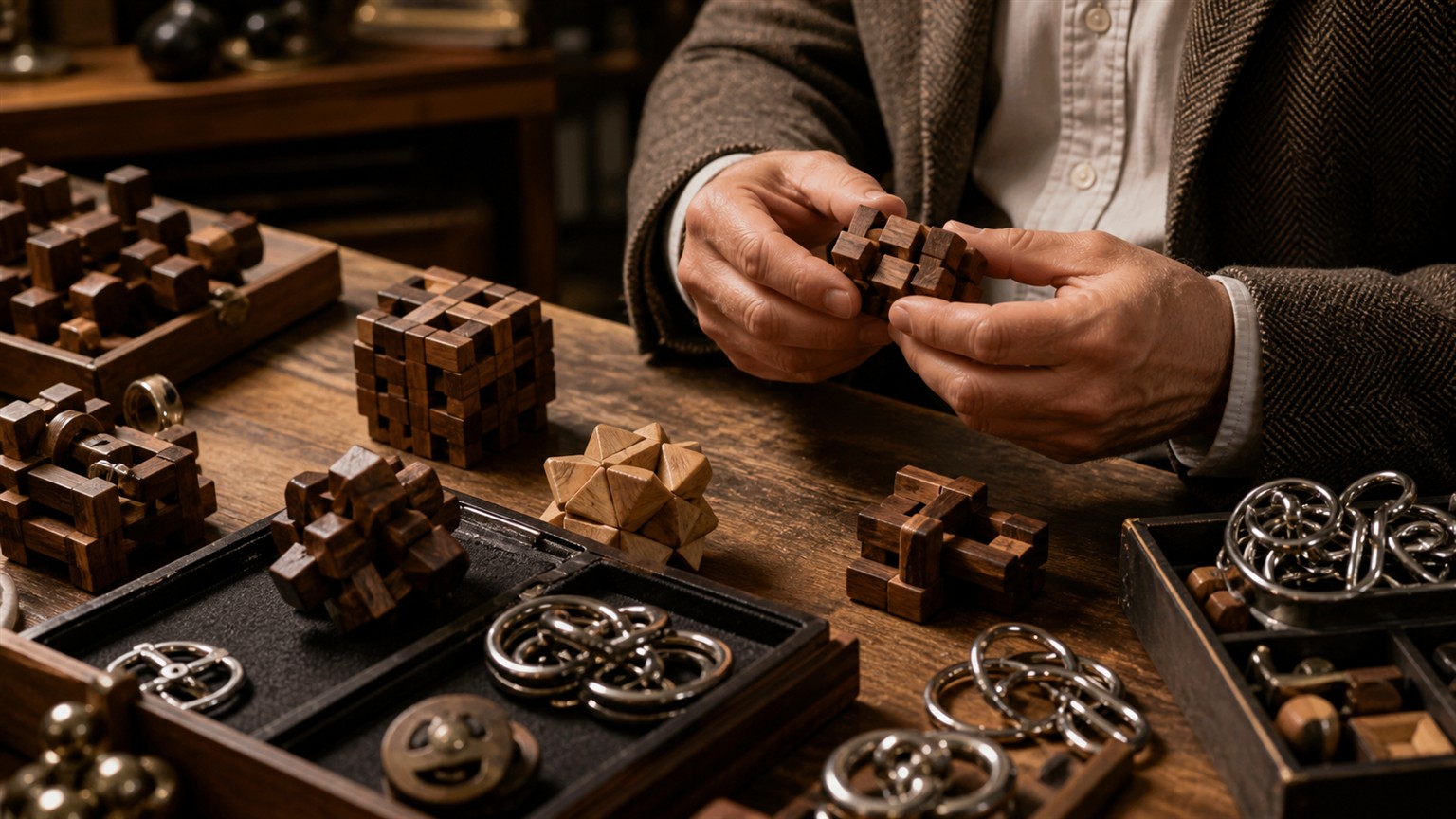
Mechanical puzzle challenges ask solvers to think with their hands. A wooden burr, a trick box, a metal disentanglement, or a sequential movement puzzle does not reveal its logic all at once. It pushes back, catches, loosens, resists, and occasionally surprises the solver with a movement that felt impossible a minute earlier. Serious hands-on solving is not about forcing pieces apart. It is about reading physical feedback patiently enough that the puzzle begins to explain its own constraints.
A: They combine hidden structure, spatial constraints, tactile feedback, and careful sequencing.
A: No; serious solving uses gentle pressure and stops when resistance feels wrong.
A: Yes, especially when they preserve the puzzle and keep learning alive.
A: An interlocking puzzle usually made of notched pieces that release in a specific sequence.
A: Solve over a tray and store removed parts immediately.
A: Yes; repeated solves improve touch, memory, and spatial prediction.
A: Notes preserve legal states and help separate discovery from guesswork.
A: Start with well-reviewed moderate puzzles before expensive collector pieces.
A: Moves become more deliberate and reset sequences become easier to explain.
A: A fair mechanism, satisfying movement, and a solution that feels surprising but coherent.
Hands Are Part of the Reasoning
Mechanical puzzles are not simply logic puzzles made from wood or metal. The hand is part of the reasoning system. A solver feels whether a piece has slack, whether a ring path is opening, whether a box panel has shifted, or whether a movement is approaching the edge of safe pressure. That information is not decorative. It is evidence.
Serious solvers learn to slow down enough to notice that evidence. They do not treat the puzzle as a stubborn object to defeat. They treat it as a designed conversation between motion and constraint.
The First Session Should Be Exploratory
The first session with a mechanical puzzle should often be exploration, not conquest. Turn the object. Feel its range. Notice which pieces move independently and which ones seem coupled. Ask what kinds of motion are allowed before trying to create a full solution path.
This exploratory mindset reduces damage and frustration. It also builds a mental map. When the real solution attempt begins, the solver already has a sense of the puzzle's vocabulary.
Why Force Is Usually Bad Information
Force can create the illusion of progress because something moves. Unfortunately, that movement may be a bent ring, a compressed wooden joint, or a damaged mechanism. Mechanical puzzles are built around tolerances. Respecting those tolerances is part of solving.
A useful rule is simple: pressure may be firm, but it should not feel violent. If the puzzle seems to require rough treatment, pause and reassess. The missing move is usually a sequence, alignment, or orientation, not more strength.
Notation Helps With Complex Sequences
Serious hands-on solvers often need memory support. A sequential movement puzzle or complex burr may pass through many states before release. Without notes, the solver can discover a path and lose it almost immediately.
Notation does not need to be formal. A few orientation sketches, move names, photos of stable states, or short descriptions can preserve insight. The point is to reduce accidental backtracking and make learning visible.
The Reset Is Part of the Challenge
Many mechanical puzzles are only half solved when taken apart. Reassembly or reset can be as demanding as the opening. This is especially true for interlocking puzzles whose internal geometry is easier to disturb than understand.
Treat reset with respect. Lay pieces out in order, avoid mixing similar parts, and pause before celebrating too hard. A puzzle that cannot be reset becomes a problem for future-you.
Hints Can Be Used Skillfully
A hint does not have to spoil the experience. The best hint may name a region, confirm a legal movement, or suggest a goal state without revealing the full sequence. Serious solvers can use hints as learning tools rather than admissions of defeat.
This is especially important for expensive, rare, or delicate puzzles. Protecting the object matters. A well-timed hint may save both the puzzle and the solver's patience.
Choosing Difficulty Without Ego
Mechanical puzzle difficulty can be humbling because it is hard to scan from the outside. A beautiful object may be approachable, while a simple-looking ring puzzle may hide a brutal path. Buying only the hardest puzzles is often a recipe for stalled shelves.
A stronger approach is a difficulty ladder. Choose puzzles that stretch one skill at a time: burr disassembly, coordinate motion, disentanglement, hidden mechanisms, or reassembly memory. Skill grows faster when the challenge is readable.
Care and Storage Matter
Physical puzzles age. Wood swells, metal scratches, small parts vanish, and mechanisms can become gritty. Serious solving includes care: clean hands, dry storage, soft surfaces, and patience with delicate movements.
This care is not preciousness. It preserves the puzzle as a playable object. A well-maintained mechanical puzzle can teach many solvers over many years.
Challenge Formats for Advanced Practice
Once a puzzle is solved, the challenge can continue. Try explaining the mechanism without touching it. Reassemble from memory after a week. Solve with one observer who asks only clarifying questions. Compare two puzzles by the same maker and notice shared design habits.
These formats turn completion into mastery. They move the solver from getting through the puzzle once to understanding how the puzzle thinks.
Reading Maker Style
Many mechanical puzzle makers have recognizable habits. One may favor elegant coordinate motion, another hidden magnets, another brutal reassembly, and another playful misdirection. Learning a maker's style helps serious solvers approach new puzzles with better expectations.
This does not mean solving becomes easy. It means the solver starts asking more informed questions. What kind of movement does this designer enjoy? Where might the surprise be hidden? What would be too obvious for this object?
When to Walk Away
Walking away is a legitimate mechanical puzzle technique. A tired hand becomes rough, and a tired mind repeats the same move. Leaving the puzzle overnight often restores tactile listening.
The return can feel almost magical. A movement that was invisible during frustration may become obvious after rest because the solver is no longer trying to force the same story onto the object.
Ethics Around Spoilers
Mechanical puzzle communities often care deeply about spoilers because a single photo or move sequence can erase the discovery. If you share progress online, avoid revealing hidden mechanisms or final states unless the space clearly allows spoilers.
This etiquette protects other solvers and respects makers. A puzzle's mystery is part of its value.
Building a Serious Collection
A serious collection should not be only a shelf of unsolved trophies. Choose puzzles that teach different skills, represent different makers, and invite repeat solving. Keep notes about difficulty, mechanism type, and what the solve taught you.
Quality matters more than quantity. A small collection that you understand deeply can be more satisfying than a crowded shelf that mainly produces guilt.
Documenting Without Spoiling Yourself
Documentation can help, but it can also drain the mystery if it becomes too detailed too early. During first exploration, record stable states and observations rather than a full assumed solution. Let the puzzle keep some uncertainty while you gather evidence.
After solving, your notes can become more explicit. That is when a clean reset sequence, mechanism sketch, or personal solve summary becomes useful. The timing of documentation matters.
Why Repetition Builds Tactile Memory
Repeated solving teaches the fingers what the mind once had to reason through. A movement that was confusing on the first solve becomes a recognizable feel on the fourth. This tactile memory is one of the pleasures of mechanical puzzles.
Repetition also reveals elegance. The first solve may feel like survival. Later solves show why the mechanism was designed that way and where the cleverness lives.
Advanced Challenges Need Boundaries
Serious solvers sometimes enjoy long battles with difficult objects, but boundaries protect the experience. Decide how long to work before taking a break, whether hints are allowed after a certain point, and how you will avoid damaging the puzzle.
A boundary is not a retreat. It is a way to keep the puzzle playable and the solver thoughtful.
Learning From Failed Attempts
A failed attempt can teach orientation, illegal movement, false assumptions, or the limits of a mechanism. The trick is to notice what failed instead of simply trying harder. Mechanical puzzles reward diagnostic patience.
After a stalled session, write one sentence about what you learned. That sentence can make the next return sharper.
Why Materials Change the Solve
Wood, metal, plastic, and printed materials communicate differently. Wood may have warmth and slight tolerance variation. Metal may demand delicate alignment. Plastic may allow bright geometry and smoother repetition. The material changes how the puzzle feels and how the solver listens.
Serious hands-on solving pays attention to that material voice. A move that feels natural in one material might feel risky in another.
Comparing Discovery and Performance Solves
The first solve and the performance solve are different experiences. The first solve is about discovery, uncertainty, and learning the puzzle's boundaries. A performance solve is about repeating the sequence cleanly, perhaps under time pressure or while explaining the mechanism to someone else.
Both have value. Discovery teaches patience and inference. Performance teaches memory, precision, and respect for sequence. Serious solvers can enjoy both without confusing them.
Why Some Puzzles Stay Interesting After Solving
A mechanical puzzle can remain interesting after the solution is known because the movement itself is satisfying. The click of a hidden mechanism, the release of a burr piece, or the smooth disentanglement of rings can feel elegant each time. This repeat pleasure separates good mechanical design from a one-time trick.
A solved puzzle may also become a teaching object. Showing another solver how to explore without spoiling the answer can deepen your own understanding.
Handling Expensive or Rare Puzzles
Expensive or rare puzzles deserve a more cautious solving style. Work over a protected surface, avoid food and drinks nearby, and learn whether the material has special care needs. If the maker provides handling notes, read them before beginning.
The cost should not make the puzzle untouchable, but it should increase respect. A serious collection is meant to be played, preserved, and shared responsibly.
The Community Side of Serious Solving
Mechanical puzzle communities are often built around trust: spoiler warnings, careful trading, maker respect, and appreciation for craft. Joining that community can help solvers discover better puzzles and better solving habits.
The best conversations are not only about difficulty. They are about elegance, surprise, fairness, materials, and the feeling of the solve. Those conversations make serious hands-on puzzling richer.
Pacing a Long Solve
Some mechanical puzzle solves unfold across days or weeks. That long pace can be part of the pleasure if the solver keeps the puzzle visible, records stable states, and returns with curiosity rather than guilt.
A long solve should not feel like a stalled failure. It can become a slow relationship with an object that keeps offering small clues.
Respecting Beginner Hands
Serious solvers sometimes forget how strange mechanical puzzles feel at first. When sharing a puzzle with beginners, explain safe handling, legal exploration, and how to stop before forcing. A gentle introduction protects both the object and the new solver's confidence.
Teaching well is a serious skill. It requires patience with the early confusion that experienced hands no longer feel.
Conclusion: Respect the Object
Mechanical puzzle challenges are rewarding because they make thought tactile. The solver learns through touch, patience, restraint, and careful memory. The best moments feel almost impossible and then suddenly obvious.
For serious hands-on solvers, the guiding principle is respect: respect the object, the maker, the mechanism, and your own attention. That respect is what makes the challenge deeper than a simple test of persistence.