Home Puzzle Challenges Turn a Table Into a Playground
The best physical puzzle challenges you can do at home use ordinary space in a surprisingly rich way. A table, a timer, a box of pieces, a few locks, or a mechanical puzzle can create focus, laughter, frustration, and teamwork without needing a screen. Physical puzzles are satisfying because the hands are involved. You feel weight, texture, resistance, fit, and motion. That tactile feedback changes the challenge and makes home puzzle play feel concrete, social, and memorable.
A: A clear goal, fair difficulty, tactile interest, and setup simple enough to repeat.
A: No; household objects, jigsaws, cards, and simple locks can work well.
A: No; timers add energy but should stay optional for anxious players.
A: Station rotations, cooperative lockboxes, and visual sorting tasks usually work well.
A: Use hints, smaller tasks, and puzzles with visible progress.
A: Yes, especially when the task is hands-on and free from screen interruptions.
A: Unsafe props, unclear rules, fragile pieces, and challenges that humiliate players.
A: Three to five stations can fill a strong home puzzle night.
A: Absolutely; mechanical puzzles, jigsaws, and timed personal challenges work solo.
A: A satisfying reveal, shared discovery, and a challenge matched to the room.
Start With the Space You Have
A home puzzle challenge does not need a dedicated game room. A kitchen table, coffee table, floor mat, or folding card table can work if the surface is clear and the lighting is good. Physical puzzles need room for pieces, hands, notes, and the occasional failed attempt.
The space should make the challenge feel inviting. If players are cramped, worried about breaking something, or constantly losing small parts, the puzzle becomes friction instead of fun. Setup is part of the design.
Jigsaw Challenges Are More Flexible Than They Look
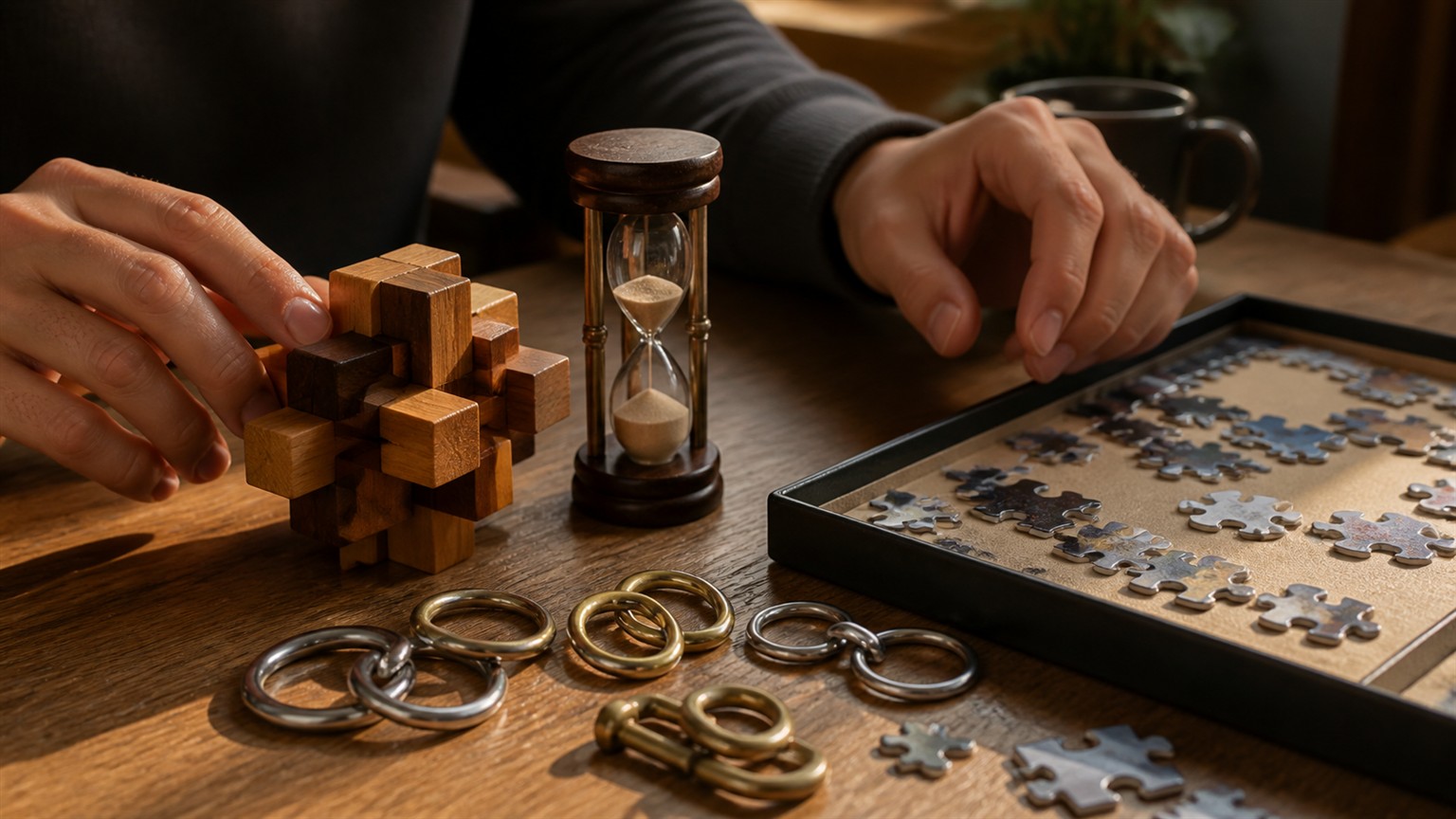
A jigsaw can become many different challenges. Teams can race to build borders, sort by color without seeing the box, assemble a small section from memory, or trade roles every few minutes. The same puzzle can be calm, competitive, cooperative, or strategic depending on the rules.
Jigsaws are especially good for mixed groups because progress is visible. Even hesitant players can sort pieces, find edges, or search for a specific texture. The challenge can scale without excluding people.
Mechanical Puzzles Reward Patience
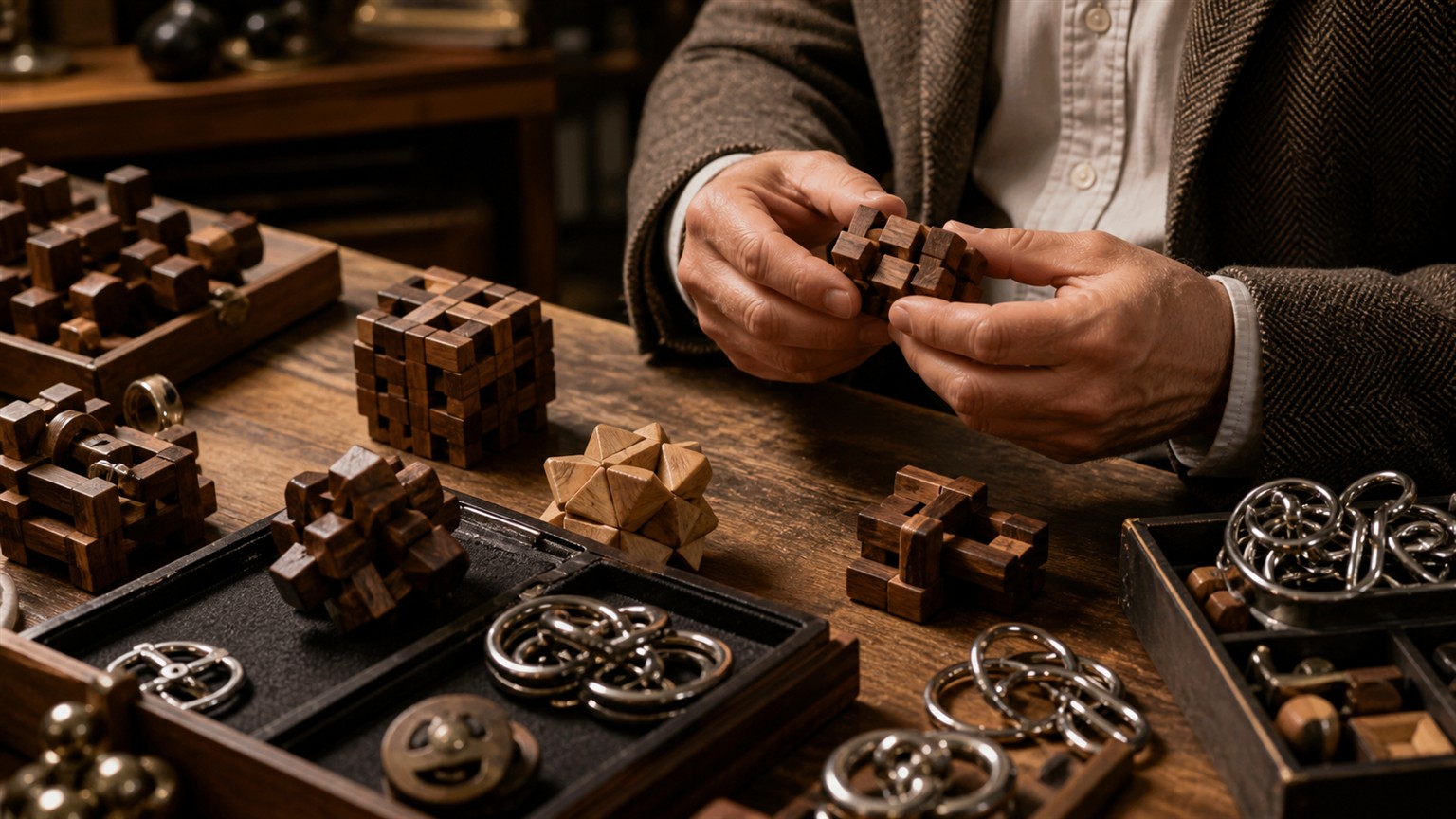
Wooden burr puzzles, disentanglement puzzles, sequential movement puzzles, and trick boxes create a different kind of home challenge. They ask players to feel resistance, notice small movements, and resist forcing a solution. The hands learn along with the mind.
These puzzles work well as stations because one person or a small pair can focus deeply while others try different tasks. Rotating stations prevents a single hard object from stalling the whole night.
Mini Escape Tables Bring Story Home
A mini escape table can be built from envelopes, boxes, simple locks, clue cards, and household props. The goal might be opening a final container or assembling a secret message. The design does not need expensive electronics. It needs clear clue flow.
Keep the story simple. A missing recipe, lost treasure, secret workshop, or mystery package gives enough motivation. The puzzles should do the real work.
Timed Challenges Need Consent
Timers can add excitement, but they also change the emotional tone. Some players enjoy racing. Others freeze or feel judged. The best home puzzle nights treat timers as a mode, not a mandate.
One approach is to run two rounds: a relaxed discovery round and a timed mastery round. Players learn the task first, then choose whether speed sounds fun. This keeps pressure playful.
Use Hints as Design, Not Rescue
Hints should be prepared before the challenge begins. A good hint gives direction without giving away the solution. It might point to a category, suggest a sorting method, or remind players of an overlooked object.
Prepared hints prevent awkward improvisation. They also make the host feel less like a judge and more like a guide. That matters when family or friends have different frustration thresholds.
Make Tactile Variety Part of the Fun
Physical puzzles shine when materials differ. Wood, metal, paper, string, magnets, tiles, and containers each invite different movements. A strong home challenge night might include one visual task, one dexterity task, one deduction task, and one assembly task.
This variety gives different players a chance to excel. The person who struggles with word clues may be brilliant with spatial assembly. The person who dislikes dexterity may shine during deduction.
Design for Repeat Play
A home challenge is better when it can be repeated or modified. Change the time limit, swap teams, hide pieces differently, add a no-talking round, or reverse the goal. Repeat play turns a one-time setup into a reusable puzzle playground.
Keep notes after a successful night. Which station worked? Which one dragged? Which hint saved the mood? Those notes make the next version smoother.
Keep Competition Friendly
Competition can energize a puzzle night, but it should not overwhelm the social purpose. Use cooperative scoring, team rotations, or personal bests when mixed ages or skill levels are involved. The goal is lively effort, not embarrassment.
If a challenge is for children, seniors, or anxious players, reward teamwork and strategy as much as speed. Physical puzzle play should leave people wanting another round.
Build Around What People Can Touch
A strong physical challenge should make use of touch rather than merely imitate a paper puzzle. Weight, fit, texture, motion, and resistance are the reasons to do this at a table. Let players turn, sort, stack, slide, unlock, and assemble.
This tactile quality is especially good for groups that spend much of the day on screens. The challenge feels different because the body is involved. The hands slow the mind down in a useful way.
Create Stations for Mixed Groups
Stations solve a common home puzzle problem: people have different strengths. One station can be visual, another mechanical, another deductive, and another cooperative. Players rotate, compare discoveries, and avoid being trapped by one hard puzzle.
Stations also help hosts manage energy. If a task stalls, the group can move and return later. That motion keeps the event playful.
Use Reveals to Create Momentum
Physical puzzles feel satisfying when something opens, fits, releases, unfolds, or completes. A good home challenge can use small reveals to keep momentum: a box opens to show another object, a solved pattern reveals a placement, or a completed assembly unlocks the next station.
Reveals do not need to be expensive. They need to be clear. Players should know that their effort changed the state of the game.
Keep the Rules Short
Home puzzle nights work best when rules fit in a few sentences. If the host needs a long explanation, players may become cautious before the fun begins. The objects on the table should communicate much of the challenge.
Short rules also reduce disputes. Everyone understands what counts as success, what may be touched, and when hints are available.
Turn Cleanup Into Reset
Physical puzzles create clutter. Build cleanup into the design by using trays, bags, labeled containers without visible game text during play, or station mats. When a station ends, pieces return to their place before the next round begins.
A tidy reset makes the challenge reusable. It also keeps the host from ending a fun night with a discouraging mess.
Design a Difficulty Ramp
A home puzzle night should not begin with the hardest object on the table. Start with a quick win that teaches the format, then introduce tasks with more steps, ambiguity, or coordination. A difficulty ramp builds confidence before it asks for persistence.
This is especially useful for groups with children or first-time players. Early success lowers self-consciousness. Later challenge then feels like an invitation rather than a wall.
Make Hints Physical Too
Hints for physical puzzle challenges can be physical objects: a sorted tray, a colored token, a covered example, or a second copy of a shape. Physical hints feel less like a lecture and more like another part of the play space.
A hint object can guide attention while preserving discovery. It lets the player make the final connection with their own hands.
Use Constraints to Refresh Familiar Puzzles
A familiar puzzle becomes new when the constraint changes. Build without talking. Sort pieces using only one hand. Solve a small jigsaw without the image. Assemble a shape after viewing it for only a brief moment. Constraints transform known materials into fresh challenges.
Use constraints carefully. They should create playful focus, not humiliation. If a constraint makes the task inaccessible or stressful, change it.
Host Like a Game Master
The host's job is to protect flow. Explain the goal, watch frustration, offer hints, keep pieces organized, and celebrate clever moves. The host does not need to be theatrical, but they do need to pay attention.
Good hosting turns a pile of puzzles into an experience. It makes players feel that the evening has shape, fairness, and momentum.
Solo Physical Challenges Can Be Deep
Physical puzzle challenges are not only for groups. A solo solver can set a personal goal, record attempts, revisit a mechanical puzzle over several days, or build a jigsaw in themed sessions. The tactile quality can make solo practice feel grounded and absorbing.
Solo play also removes performance pressure. The solver can linger, fail, reset, and return at their own pace. For many people, that is the ideal form of challenge.
Match Challenge Length to the Room
A home challenge should fit the available attention span. A fifteen-minute station works well during a party. A two-hour jigsaw session fits a quiet evening. A multi-day mechanical puzzle can sit on a side table for slow return.
Length is a design choice. When the challenge matches the social setting, players are more likely to leave energized instead of exhausted.
Use Everyday Objects Creatively
You can build a surprisingly good physical puzzle challenge from coins, cups, string, envelopes, boxes, kitchen timers with markings hidden, cloth bags, and blank cards. The trick is giving each object a clear purpose and avoiding clutter that looks playable but is not.
Homemade challenges work best when every object belongs. If an item is only decoration, keep it away from the active table or make its non-role obvious.
Let Players Debrief the Strategy
After a challenge, ask what strategy worked. Did sorting help? Did someone notice a repeated shape? Did slowing down prevent forced moves? A short debrief turns a fun activity into a learning loop.
Keep it conversational rather than formal. The point is to notice clever habits and carry them into the next puzzle, not to grade the evening.
Make Storage Part of the Plan
Physical puzzle hobbies become easier when storage is solved. Use trays, cloth bags, small boxes, or dedicated shelves so pieces do not vanish between sessions. A puzzle that is easy to pause is easier to resume.
Storage also helps families and shared households. When the setup can be protected, longer challenges do not have to be rushed.
Photograph the Final Setup Without Spoilers
For reusable home challenges, take a private photo of the reset state after the game ends. This helps the host rebuild the station later without relying on memory. Keep that photo away from future players so it does not spoil the challenge.
A small reset habit turns a successful one-night activity into a repeatable tradition.
Rotate Favorites Back In
When a home challenge works, bring it back with one new twist. Familiar favorites create tradition, while a small rule change keeps the table from feeling repetitive.
Conclusion: Make the Challenge Touchable
Physical puzzle challenges work because they make problem solving touchable. Players can pick up the pieces, test a motion, pass an object, and see progress on the table in front of them.
Start with simple materials, fair rules, and a challenge matched to your group. A good home puzzle setup turns ordinary objects into an evening of discovery.