A Simple Mechanic Became a New Puzzle Language
Portal and Portal 2 redefined puzzle games because they turned one clear idea into a complete language of space. The player learns to think with linked surfaces, momentum, line of sight, timing, physics, and environmental logic. What makes the series remarkable is not only the famous mechanic. It is how patiently the games teach that mechanic, how cleanly they escalate it, and how much personality they build around rooms that are, at heart, logic problems in three dimensions.
A: It turns a simple spatial mechanic into a deep and readable puzzle language.
A: It is broader and longer, with more mechanics and co-op, but still teaches carefully.
A: Mostly no; the series emphasizes spatial reasoning, timing, and planning.
A: It keeps repetition lively and softens failure without weakening the puzzles.
A: Communication, synchronized action, and shared spatial planning.
A: Yes, especially because early puzzles teach the rules clearly.
A: Spatial reasoning, systems thinking, and cause-and-effect planning.
A: They usually show relevant surfaces, objects, and goals cleanly.
A: Mechanic escalation, feedback, pacing, and how story supports problem solving.
A: Their core design lessons remain useful across puzzle games.
The Mechanic Is Easy to State
A great puzzle mechanic can often be explained quickly. Portal's central idea is simple: two linked openings connect distant spaces. That clarity is powerful because players understand the rule before they understand its consequences.
The game then spends its time exploring those consequences. What happens when height becomes speed? What happens when an object moves through the same link? What happens when a room is solved by seeing a surface from the right angle? The depth comes from the rule unfolding.
The Rooms Control Attention
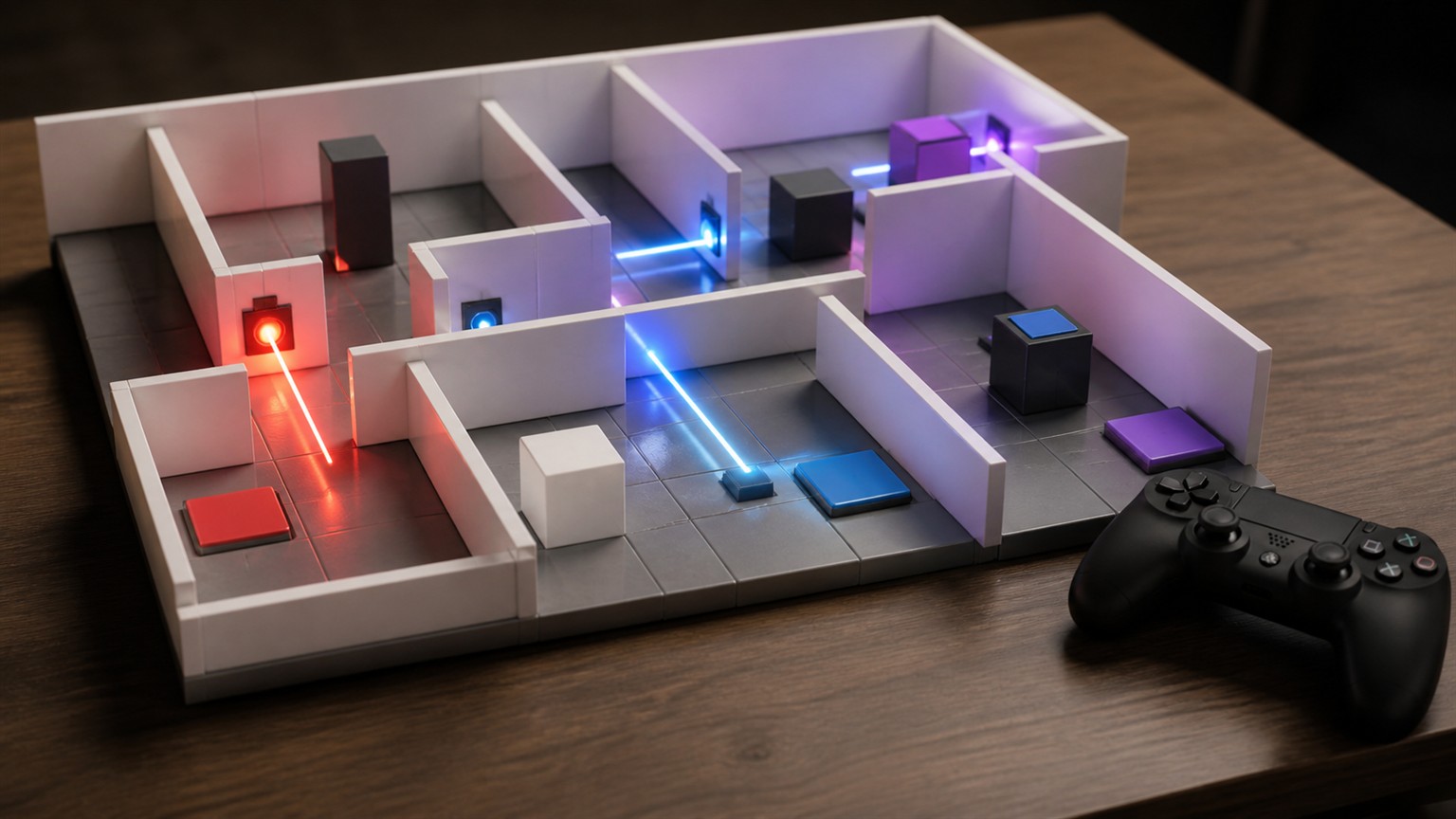
Portal's test chambers are readable because they control attention. Walls, floors, buttons, cubes, hazards, and exits are arranged with strong visual logic. The player can scan the room and begin forming a plan instead of wondering what is interactable.
This restraint is a major design lesson. A puzzle room does not need to be visually busy to be interesting. It needs the right information in the right places.
Failure Is Quick and Often Funny
Puzzle games can become frustrating when failure is slow, punishing, or unclear. Portal softens failure with quick resets, consistent physics, and a comic tone that makes mistakes feel survivable. The player experiments because the cost of experimentation is reasonable.
This emotional design matters. When players are willing to test ideas, they learn faster. A funny failure can keep the mind open long enough for the next attempt to work.
Portal 2 Broadens the Language
Portal 2 expands the original idea without burying it. New mechanics such as movement-altering surfaces, temporary paths, and larger room structures add variety, but the central spatial language remains. The player still solves by asking how space can be connected, redirected, or reinterpreted.
That continuity is why the sequel feels generous rather than scattered. It offers more tools, but the old grammar still matters.
Story Supports the Puzzle Rhythm
The series uses story and voice to manage pacing. Dialogue fills travel time, gives personality to repeated testing, and lets the world feel alive without requiring long interruptions. The humor becomes part of the rhythm of solving.
This is difficult to balance. Too much story can smother puzzle focus. Too little can make rooms feel sterile. Portal and Portal 2 sit in a memorable middle ground.
Co-Op Turns Space Into Conversation
Portal 2's cooperative mode changes the puzzle from private reasoning into shared communication. Two players must describe views, coordinate timing, trust each other's setup, and sometimes understand a room from different positions.
That makes co-op more than extra content. It reveals a different side of the mechanic. The puzzle is not only where to place the connection; it is how to make another person see the plan.
Why the Series Influenced Designers
Designers study Portal because it shows how to introduce a strange rule and make it feel natural. The games teach through safe examples, then combine ideas until players feel clever for using what they already learned.
That design pattern appears far beyond first-person puzzle games. Any puzzle designer can learn from the series' clarity, pacing, feedback, and respect for player discovery.
The Puzzles Are Systems, Not Riddles
Portal puzzles usually do not depend on guessing a hidden answer. They depend on understanding a system. The room contains objects, surfaces, movement, and hazards with consistent relationships. The solution emerges when those relationships are arranged correctly.
This systems quality gives the puzzles lasting appeal. Once solved, they often feel inevitable. The player can see why the answer works, not merely that it worked.
What Players Can Learn From Portal
Players can carry several habits from the series into other puzzles: scan the whole system, test safely, think in reverse from the exit, and ask how one rule can be used in a new way. These habits apply to physical puzzles, escape rooms, and logic games as well.
The series also teaches patience with perspective. Sometimes the solution appears only when the player changes position, mentally or literally.
Why Constraint Made the Idea Stronger
Portal's early restraint is part of its genius. The game does not drown players in tools. It gives them one strange power and then designs rooms that reveal the power's implications. Constraint makes the learning cleaner.
Portal 2 broadens the toolkit, but it still benefits from that foundation. New mechanics work because the player already trusts the spatial rule beneath them. The sequel expands from a clear center rather than replacing it.
The Series Makes Players Feel Clever
A Portal solution often feels surprising and obvious at the same time. That is a rare design achievement. The player struggles, reframes the room, acts, and then sees that the answer was sitting inside the rules all along.
This feeling is different from being tricked. The game wants the player to feel clever because the puzzle was fair. That emotional payoff is a major reason the series remains beloved.
Readable Spaces Support Wild Ideas
The mechanic is strange, but the spaces are readable. Clean surfaces, clear hazards, distinct objects, and strong goal placement help players focus on the spatial idea rather than the visual clutter. The room tells players what kind of thinking is relevant.
This lesson applies to physical escape rooms and tabletop puzzles too. The stranger the concept, the clearer the presentation needs to be.
Co-Op Shows the Limits of Private Insight
In solo play, understanding can remain internal. In co-op, a player has to translate insight into language. They must describe positions, timing, angles, and intentions to someone who may see a different part of the room.
That communication demand makes co-op Portal 2 a landmark of collaborative puzzle design. The solution is not complete until both players can coordinate it.
Momentum Made Space Feel Physical
The series' use of momentum turns abstract space into something players feel. Falling, launching, redirecting, and carrying speed through linked spaces make the mechanic more than a doorway trick. The player learns to think with motion.
That physical intuition is why many solutions feel thrilling even when they are logical. The body imagines the arc before the controller executes it. A puzzle becomes a planned movement through possibility.
The Games Respect Silence
Despite their famous dialogue, the games also understand silence. Many rooms give players time to look, think, and test without constant instruction. That quiet is important because spatial reasoning needs mental room.
The comedy works partly because it does not explain every solution. The player still owns the key insights. Personality surrounds the puzzle without swallowing it.
Portal 2's Co-Op Is a Separate Design Achievement
The co-op campaign is not simply harder solo play with two bodies. It is designed around gestures, split views, simultaneous actions, and trust. The players must build a shared model of the room.
This makes the experience unusually social for a puzzle game. Miscommunication becomes part of the challenge, and a clean solve feels like a team accomplishment rather than one person's private insight.
Why the Series Avoids Puzzle Exhaustion
The games vary tone and pace before the player burns out. Story sequences, visual changes, new tools, and comedic interruptions give the mind brief resets. This pacing keeps difficult puzzle work from feeling monotonous.
Puzzle designers can learn from that rhythm. Even excellent mechanics need breathing space. A player who gets to reset emotionally can return to hard thinking with more patience.
A Lasting Lesson for Puzzle Fans
For players, the lasting lesson is to search for the rule beneath the room. What is consistent? What can be moved? What changes perspective? What happens if the solution is approached backward from the exit?
Those questions travel well. They apply to escape rooms, mechanical puzzles, logic grids, and even everyday problem solving. That is why the series' influence reaches beyond its own genre.
Teaching Through Safe Experiments
The series often lets players test an idea safely before that idea becomes necessary under pressure. A room may introduce a movement concept in a low-risk way, then later require the same concept with timing, hazards, or multiple steps.
This sequence makes advanced puzzles feel fair. The player recognizes the ingredients, even when the arrangement is new. Good teaching does not remove challenge; it prepares the mind to meet it.
Why Humor Does Not Undercut Serious Design
The humor in Portal and Portal 2 can make the games feel light, but the design underneath is disciplined. Jokes fill the space around thinking. They do not replace puzzle logic. That balance is harder than it looks.
The result is a rare tone: playful, eerie, precise, and humane toward the player. The games can be funny while still asking for real spatial reasoning.
What Modern Designers Still Borrow
Modern puzzle games still borrow the series' lessons: isolate a rule, teach through interaction, keep feedback readable, escalate by combination, and use narrative pacing to refresh effort. Those lessons remain useful even in games with completely different mechanics.
That is the mark of a genre-defining work. Its influence is not limited to imitation. It becomes part of how designers think.
The Sequel Understands Scale
Portal 2 becomes larger without losing the player's sense of place. Bigger environments, longer story beats, and additional mechanics could have made the puzzle language messy. Instead, the sequel uses scale to vary emotion and pacing.
That control of scale is part of its achievement. The game feels expanded, not inflated.
Why the Series Is Still Approachable
Despite its reputation, the series remains approachable because the early learning curve is kind. Players are allowed to experiment, observe, and laugh before the hardest combinations appear. The games trust curiosity more than prior expertise.
That makes the series a useful recommendation for people who think they are not puzzle-game players. It teaches them the language while making the learning feel like play.
A Clean Idea Can Carry a World
The series also proves that a clean idea can carry a whole fictional world. Players remember the jokes and atmosphere, but the reason the world works is that its central rule remains so playable. Every room keeps returning to that promise, even when the setting becomes stranger, funnier, larger, and more elaborate.
Conclusion: A Benchmark for Elegant Escalation
Portal and Portal 2 redefined puzzle games because they made spatial reasoning feel intuitive, funny, and profound. They proved that a single mechanic can support a rich world when taught with care.
Their legacy is not only a famous device or memorable dialogue. It is a standard for elegant escalation: teach clearly, combine bravely, and trust the player to discover the shape of the idea.