Why Puzzle Insight Feels Sudden
The Aha moment feels as if the answer arrives all at once, but the brain has usually been working toward it for longer than the solver realizes. A puzzle clue, pattern, or contradiction may sit quietly in attention while the mind tests possible frames in the background. When the right interpretation finally connects the pieces, the result can feel immediate, emotional, and obvious in hindsight. That is why puzzle insight is so memorable. It is not simply finding an answer; it is the experience of a confused situation reorganizing into a coherent one.
A: Insight often reorganizes several clues at once, so the answer feels supported before every detail is verbalized.
A: No. A guess may be unsupported, while insight usually makes the setup more coherent after the answer appears.
A: Yes, a break can loosen fixation and let the solver return with a fresher representation of the puzzle.
A: No. Some puzzles are solved gradually through steady elimination, calculation, or construction.
A: Riddles often depend on reframing language, so the answer can transform the whole question quickly.
A: A heavy hint can, but a light hint that points attention to a clue type can preserve discovery.
A: The mind now has the organizing frame that was missing during the search.
A: Some struggle is common, but frustration helps only when it does not shut down flexible thinking.
A: They can compare clues carefully, step away when fixated, and return to test new interpretations.
A: A fair insight puzzle hides the route while leaving evidence that supports the answer after the reveal.
The Search Before the Spark
Puzzle insight begins before the satisfying click. The solver reads clues, tests patterns, rejects bad fits, and holds fragments in mind. Even when progress feels invisible, the brain is building a representation of the problem. That representation may be incomplete or partly wrong, but it gives later insight something to reorganize.
This is why the Aha moment is rarely pure magic. It often follows a period of effort that identifies the puzzle's constraints. The solver learns what does not work, which clues feel stubborn, and where the current frame is weak. Those failures narrow the space for a better interpretation.
Why Reframing Matters
Many insight puzzles are solved when the solver changes the frame. A word that sounded literal may become metaphorical. A visual pattern may stop being read as decoration and start being read as structure. A riddle speaker may turn out not to be a person at all.
Reframing is powerful because it changes the meaning of several details at once. Instead of solving one clue in isolation, the solver discovers a perspective that makes multiple clues line up. That broad fit creates the emotional punch of insight: the answer feels less like an added fact and more like the puzzle finally becoming itself.
Attention, Fixation, and Release
Attention helps by keeping the goal active, but it can also trap the solver. If attention keeps circling the same interpretation, every clue gets forced through that narrow opening. The solver may become more certain without becoming more correct.
Release matters here. A short break, a change of task, or a gentle hint can interrupt the loop. The point is not to stop thinking forever. It is to return with enough distance to notice that the old frame was optional.
The Role of Incubation
Incubation is the familiar experience of stepping away from a puzzle and later seeing a route that was hidden before. The mind may continue to process associations, but the practical benefit is also simple: distance weakens fixation. When the solver returns, the puzzle can be inspected without the same stale commitment.
Incubation works best after real engagement. If the solver never studied the clues, there is little for the mind to reorganize. A useful break follows effort. It gives the brain a chance to reset the representation rather than merely avoid the challenge.
Why the Reward Feels So Good
An Aha moment resolves uncertainty. A confusing arrangement becomes readable, and that shift is rewarding. The pleasure is not only in being right. It is in feeling disorder turn into structure.
This reward can motivate continued puzzle practice. People return to riddles, crosswords, logic grids, and visual puzzles because the mind likes the transition from not knowing to seeing. A good puzzle makes that transition feel earned.
Insight Across Puzzle Types
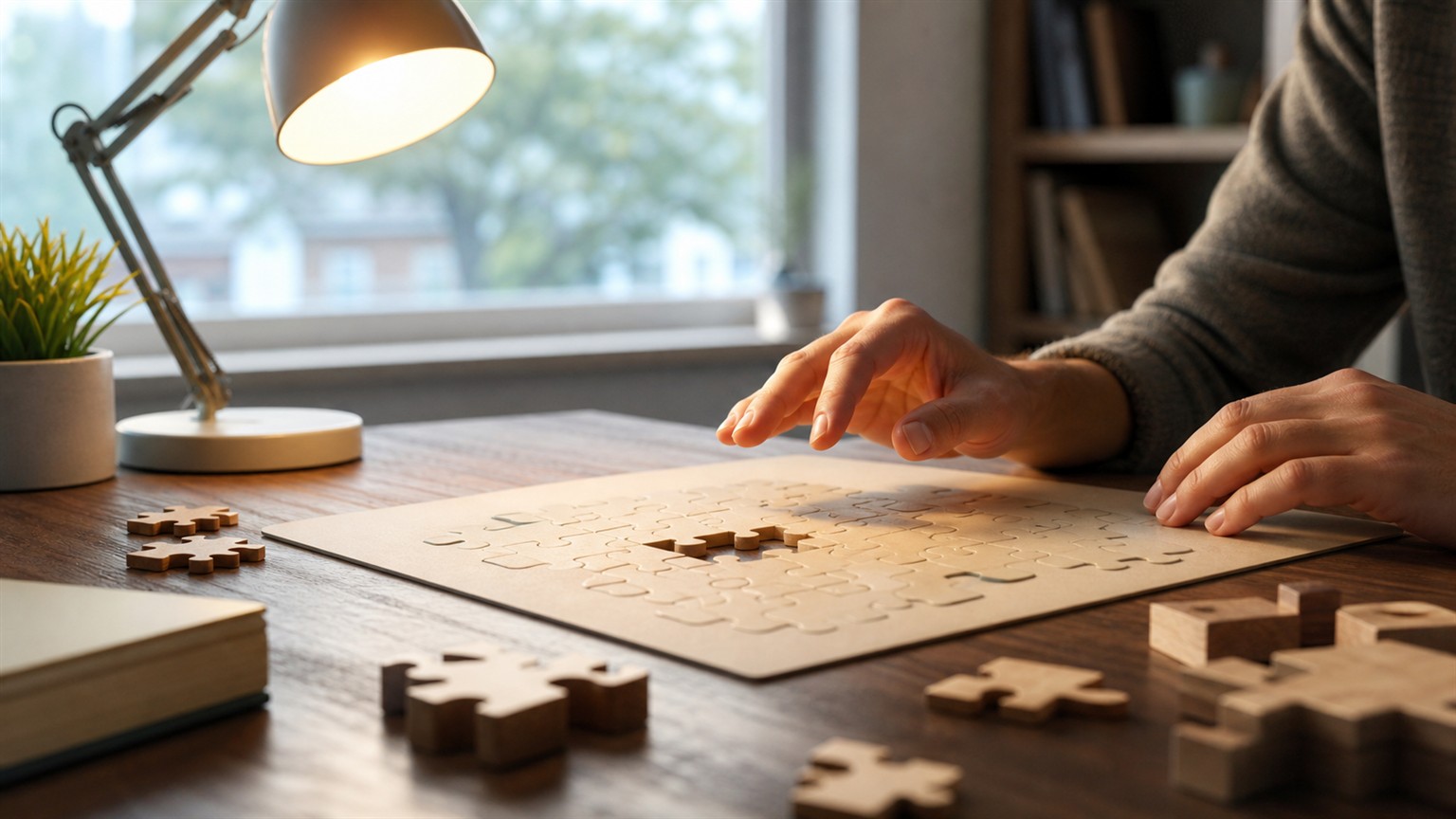
Different puzzle types create insight in different ways. A crossword answer may click when a clue's pun becomes clear. A logic puzzle may click when one contradiction eliminates a whole branch. A jigsaw may click when a color region or texture suddenly belongs to a location. A mechanical puzzle may click when a movement reveals the hidden constraint.
The common thread is reorganization. The solver stops seeing isolated parts and starts seeing relationships. That is why insight can happen in language, space, logic, memory, and physical manipulation.
How to Practice for Better Aha Moments
Practice cannot force insight on command, but it can improve the conditions around it. Solvers can learn to reread carefully, pause before committing to a frame, and ask which clue their favorite answer fails. They can also build a library of puzzle forms, making future patterns easier to recognize.
A useful practice routine alternates effort and review. Work the puzzle sincerely, take a break when stuck, then review the final answer. Ask what changed. Was it a word meaning, a spatial relationship, a hidden category, or a false assumption?
Why Explanation Still Matters
The emotional certainty of insight should still be checked. A puzzle answer is stronger when it can be explained against the evidence. If a solution ignores a clue, the feeling of insight may have been premature.
Explanation turns the moment into learning. It teaches the solver which details mattered and which habits helped. Without explanation, an Aha moment is enjoyable but slippery. With explanation, it becomes a reusable lesson.
Designing for Insight Without Trickery
A well-designed insight puzzle misdirects without cheating. It allows a tempting frame, but it also includes clues that point beyond that frame. The answer should surprise the solver and then make the setup feel fair.
Bad trickery feels different. It depends on private knowledge, vague wording, or an arbitrary leap. The solver may still be surprised, but the surprise does not educate the setup. A fair insight puzzle lets the reveal illuminate the whole path.
The Puzzle Representation Has to Change
Before an insight arrives, the solver usually has a representation of the puzzle: what kind of problem it is, which details matter, and what an answer should look like. That representation can be useful, but it can also be wrong. A riddle may be represented as a story about a person when it is really about an object. A visual puzzle may be represented as a set of shapes when it is really about changes between shapes.
The Aha moment often happens when that representation changes. The solver is not adding one more clue to the old picture. They are replacing the picture with a better one. This is why insight can feel so dramatic. The same information is still present, but it is organized under a new rule.
This also explains why rereading matters. A clue that failed inside the old representation may become decisive inside the new one. The solver discovers that the problem was not missing information; it was being viewed through a frame that made the information hard to use.
Why Incubation Is Not Doing Nothing
When a solver steps away from a puzzle, it can look as if work has stopped. In practice, the break may weaken the grip of an unhelpful interpretation. Returning later makes it easier to see the exact wording, image, or constraint without dragging the same failed answer back into the center of attention.
Insight and Emotion Work Together
The Aha moment is cognitive, but it is also emotional. Relief, surprise, delight, and confidence often arrive with the solution. Those feelings help mark the answer as important. They also make the puzzle more memorable than a solution that was reached by routine steps.
That emotional charge should still be handled carefully. Feeling certain is not the same as being correct. The best solvers enjoy the rush and then check the answer calmly. If the explanation holds across every clue, the emotion and the evidence can support each other.
Why Some Solvers See It Faster
Experienced solvers often reach insight faster because they have seen more puzzle structures. They may recognize that a clue has the shape of a homophone, that a visual pattern is changing by rotation, or that a riddle is asking for a nonhuman speaker. Their insight still feels sudden, but the route is supported by a larger library of past examples.
This does not mean insight belongs only to experts. Beginners can cultivate it by solving varied puzzles and reviewing the moment of change after each answer. The review builds a memory for frames, not just answers.
Over time, a solver becomes better at asking productive questions. What else could this word mean? What assumption did I add? Which feature changes across the examples? Those questions make insight more likely because they invite new representations.
When Step-by-Step Solving Leads to Insight
Insight and analytic solving are sometimes described as opposites, but puzzle solving often uses both. A solver may eliminate several wrong options step by step before suddenly seeing the hidden relationship. The gradual work prepares the sudden shift.
Logic grids show this especially well. A series of careful exclusions can leave one relationship exposed, and that relationship may reorganize the rest of the puzzle. The Aha moment is then not a shortcut around reasoning. It is the reward for reasoning far enough to reveal the next frame.
Using Aha Moments as Learning Data
After an insight puzzle, ask what changed. Did a word become literal? Did a shape become part of a sequence? Did a contradiction reveal that the original category was wrong? Naming the change turns the emotional moment into learning data.
This habit is valuable because the answer itself may never appear again, but the kind of shift probably will. A solver who notices their own Aha patterns becomes better prepared for future puzzles. They learn where they tend to fixate and which kinds of clues usually rescue them.
The Difference Between Insight and Confirmation
Sometimes the Aha moment is the discovery of the answer, and sometimes it is the confirmation that an answer already suspected is truly right. Those experiences feel similar, but they are not identical. Discovery changes the frame. Confirmation locks the frame into place by showing that the details fit.
Both can be valuable in puzzles. A solver may first have a faint idea, then look back through the clue wording and feel the stronger click when every part aligns. That second moment is not less important. It is the point where the mind stops merely liking an answer and starts trusting it.
Why Ambiguity Can Help
Insight puzzles often need a little ambiguity. If every clue points in a direct line, the solve becomes procedural. If the clues allow more than one early reading, the solver has room to form and revise a representation.
The ambiguity must still be controlled. Too much looseness creates arbitrary guessing. The art is to make the wrong frame plausible while leaving enough evidence for the right frame to win after careful inspection.
How to Recover After a False Aha
A false Aha moment happens when an answer feels elegant but fails a clue. The best response is not embarrassment. It is curiosity. Ask why the answer felt so good and which detail refused to cooperate.
This recovery protects the solving process. Instead of clinging to the almost-answer, the solver extracts useful information from it. A false insight often points toward the real one by revealing which feature the answer must handle better.
Conclusion: Insight Is Earned Surprise
The neuroscience of the Aha moment reminds us that sudden answers usually rest on preparation. Attention, memory, association, control, and reward all contribute to the experience of a puzzle snapping into place.
For solvers, the practical lesson is gentle but useful: struggle carefully, step away when stuck, and return ready to change the frame. The answer may feel sudden, but the mind has often been setting the stage all along.