Cognitive Engagement That Still Feels Like Play
Puzzles can support cognitive health in older adults because they combine mental engagement with enjoyment. A good puzzle invites attention, memory, reasoning, visual comparison, patience, and sometimes conversation. It gives feedback without feeling like a formal test. That distinction matters. Puzzles should not be presented as a cure or guaranteed protection against cognitive decline, but they can be a meaningful part of an active, social, and stimulating lifestyle when chosen with the right level of challenge and accessibility.
A: No single activity should be promised as prevention, though cognitive engagement can be part of a healthy lifestyle.
A: The best choices match interests, vision, dexterity, confidence, and desired challenge.
A: They can engage vocabulary, recall, and language skills, especially when the solver enjoys them.
A: They provide visible progress, spatial challenge, and a calm pace.
A: No, the right level is challenging enough to engage but not so hard that it discourages.
A: Yes, social puzzling adds conversation, support, and shared motivation.
A: Offer choices respectfully and avoid framing puzzles as a test.
A: Clear contrast, comfortable materials, readable instructions, and flexible session length help.
A: They can, if controls, screen size, and visual clarity are comfortable.
A: Emphasize enjoyable cognitive engagement, not guaranteed medical outcomes.
Why Engagement Matters
Cognitive health in later life is influenced by many factors, including physical health, sleep, social connection, learning, and daily activity. Puzzles fit into this broader picture as a form of enjoyable cognitive engagement. They ask the mind to do real work while still feeling like play.
That playfulness is important. Activities are more likely to continue when they feel satisfying. A puzzle habit that someone enjoys is more sustainable than a task they experience as homework or evaluation.
Memory, Attention, and Reasoning
Different puzzles emphasize different skills. Crosswords invite vocabulary and stored knowledge. Jigsaws ask for visual attention and spatial comparison. Logic puzzles require organization and deduction. Matching puzzles use recognition and recall.
A varied routine can touch several cognitive domains. The goal is not to max out difficulty every day. It is to keep the mind engaged in ways that are meaningful, pleasant, and appropriately challenging.
Confidence and Visible Progress
Older adults may benefit from puzzles that show progress clearly. A jigsaw border forms. A crossword corner fills in. A logic grid loses impossible options. Visible progress gives feedback and reinforces persistence.
Confidence matters because frustration can end a routine quickly. Puzzles should create enough challenge to feel worthwhile while still offering reachable wins.
Social Puzzling as Cognitive Activity
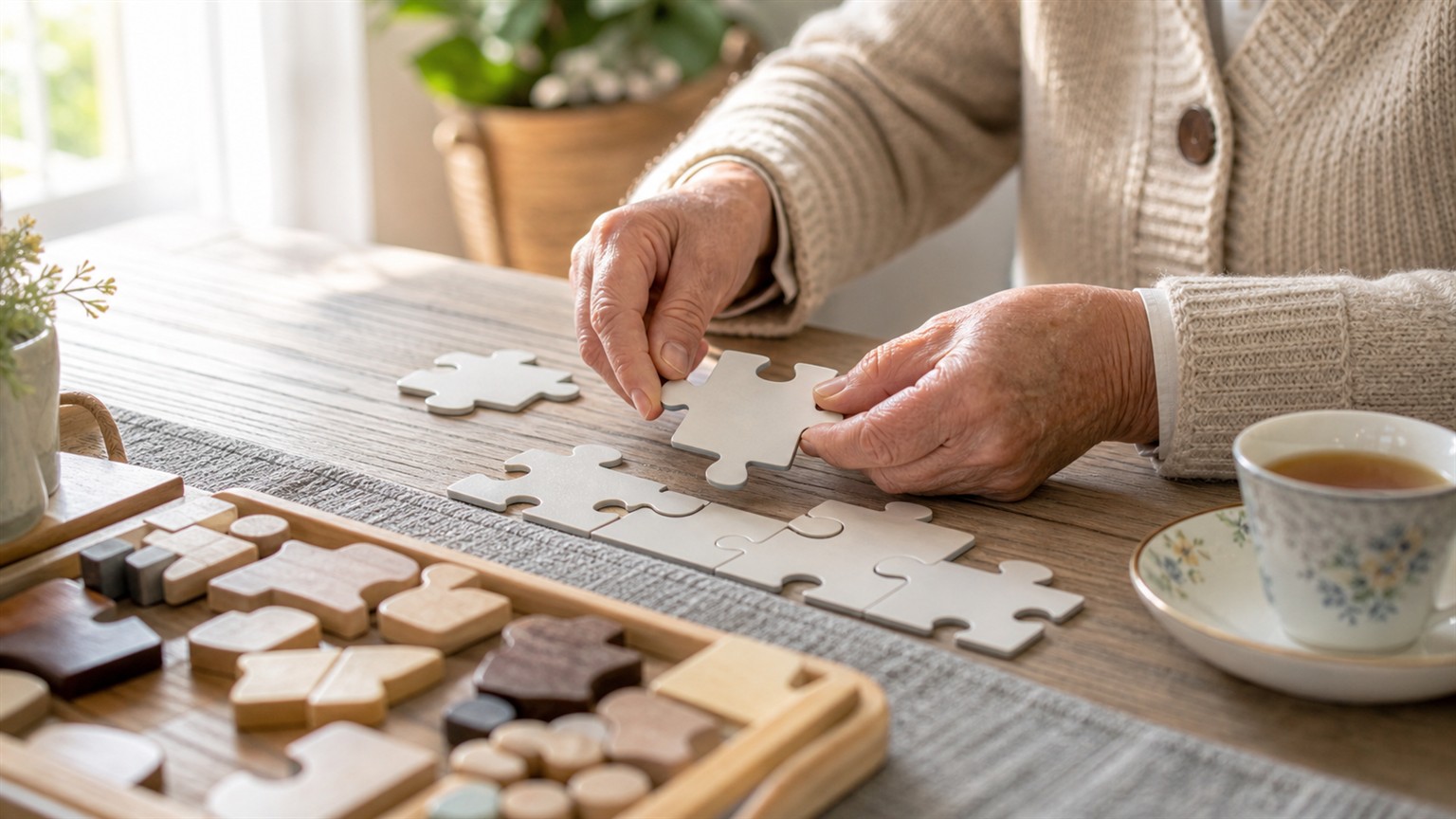
Puzzles can be social without becoming loud or competitive. A shared table invites comments, suggestions, and small discoveries. One person may notice a color region, another may remember a word, and another may keep the group organized.
This social layer adds value. Conversation reinforces memory, reduces isolation, and turns the puzzle into a shared purpose. For many older adults, that connection may be as important as the puzzle itself.
Accessibility Is Not an Afterthought
A puzzle that is theoretically useful but physically uncomfortable will not be used for long. Piece size, contrast, lighting, print size, and table height all matter. So does the emotional accessibility of the activity.
Hints should preserve dignity. Choices should be offered rather than imposed. A puzzle routine works best when the older adult feels ownership over the experience.
Choosing the Right Challenge Level
The right puzzle difficulty can change from day to day. Energy, mood, vision, pain, and environment all affect solving. A puzzle that was pleasant yesterday may feel tiring today.
Flexible challenge is the answer. Keep easier puzzles available for low-energy days and more demanding puzzles for days when the solver wants a stretch. Consistency grows from respect for real conditions.
Digital and Physical Options
Physical puzzles offer touch, movement, and visible shared space. Digital puzzles offer adjustable size, built-in hints, portability, and large libraries. Both can work well when matched to the person.
Digital puzzles need special attention to interface comfort. Small buttons, cluttered screens, or confusing menus can become barriers. The best digital option feels simple before it feels clever.
Avoiding Medical Overclaims
It is important to speak carefully about puzzles and aging. Puzzles are not a guaranteed shield against cognitive decline, and they are not a replacement for medical care. Claims should be framed around engagement, practice, confidence, and social participation.
This careful framing does not diminish their value. It makes the value more honest. Puzzles can be part of a healthy lifestyle precisely because they are enjoyable and repeatable.
Building a Respectful Puzzle Routine
A respectful routine begins with preference. Ask what kinds of puzzles feel appealing: words, pictures, objects, numbers, mysteries, or group challenges. Then adjust difficulty and format based on experience.
The routine should leave room for stopping. Ending before frustration takes over can protect the next session. A good puzzle habit invites return.
A Lifestyle Activity, Not a Medical Promise
The safest way to describe puzzles and aging is to place them within a broader lifestyle. Cognitive health is shaped by many factors, and puzzles are one form of mentally engaging activity. They can support attention, memory, reasoning, confidence, and social connection, but they should not be sold as a guaranteed prevention or treatment.
This careful wording is not a downgrade. It protects the value of puzzles by keeping expectations honest. A puzzle can be worthwhile because it gives someone a meaningful, enjoyable challenge today.
For older adults, that immediate value matters. A satisfying activity can improve the texture of a day even when long-term claims remain cautious.
Respect Is Part of Accessibility
Accessibility is not only about large pieces or bright lighting. It is also about respect. Older adults should not be handed puzzles as if they are being tested. They should be offered choices, invited into the activity, and allowed to stop without embarrassment.
How Familiarity and Novelty Can Balance
Familiar puzzle types can be comforting. A longtime crossword solver may enjoy the rhythm of clues and crossings. Someone who has built jigsaws for decades may find the sorting and fitting process calming. Familiarity reduces the barrier to starting.
Novelty also has value. A new puzzle type can invite learning and attention. The key is balance. Introduce novelty gently, perhaps by changing theme, piece count, or collaboration style before changing the whole format.
Designing for Vision, Hands, and Energy
A puzzle that ignores physical comfort can become discouraging. Older adults may need larger pieces, stronger contrast, clearer print, steadier lighting, or easier-to-grip materials. They may also need shorter sessions that respect energy and attention.
These adjustments are not simplifications of the person. They are design choices that let the real cognitive activity remain accessible.
The best puzzle setup removes avoidable barriers. Then the challenge can come from the puzzle itself rather than from glare, tiny print, or awkward handling.
Why Group Puzzling Can Be Especially Valuable
Group puzzling adds cognitive and social layers at the same time. People talk through possibilities, remember details for one another, and share small moments of progress. The activity can be collaborative without demanding constant conversation.
This makes puzzles useful in homes, senior centers, libraries, and family gatherings. A shared puzzle table allows people to enter and leave naturally. It supports connection without requiring a formal event.
Choosing Success Without Removing Challenge
A puzzle routine for older adults should include success. That does not mean every puzzle must be easy. It means the person should regularly experience progress, completion, or meaningful contribution. Challenge without success can feel like a test that keeps moving out of reach.
The right balance may involve several puzzle levels. Keep a comfortable option available, a moderate option for ordinary days, and a stretch option for times when the solver wants more. Choice protects dignity and motivation.
Interests Should Lead the Choice
The most supportive puzzle is often the one connected to a person's interests. A former teacher may enjoy word puzzles. A gardener may like nature jigsaws. A retired engineer may enjoy mechanical or spatial challenges. Personal relevance helps attention and motivation arrive naturally.
Interest also protects dignity. The activity feels chosen rather than prescribed. That sense of choice can make the difference between a puzzle that sits untouched and a puzzle that becomes part of the day.
Care Partners Can Support Without Taking Over
Family members, friends, and care partners can make puzzling easier by setting up good conditions: clear lighting, comfortable seating, organized pieces, and a relaxed amount of time. The harder skill is knowing when not to take over.
Support should preserve agency. Offer a hint, sort a few pieces together, or ask what area the person wants to work on next. Avoid turning help into correction. The goal is shared engagement, not performance management.
Puzzles for Low-Energy Days
Low-energy days need puzzle options too. A small crossword, a familiar matching set, a tray puzzle, or a short word search can provide engagement without demanding a long session. Keeping these options available helps the routine survive real life.
The presence of easier puzzles should not be treated as decline. It is simply good pacing. Everyone benefits from activities that match the day's capacity.
Tracking Enjoyment Instead of Scores
Scores and speed are not always the right measures for older adults. Enjoyment, return, conversation, calm focus, and visible participation may be better signs that the puzzle is serving its purpose. A puzzle habit can be successful even when it is slow.
This shift changes the atmosphere. The activity becomes less about proving ability and more about supporting engagement. That is where puzzles are often at their best.
Making Puzzle Time Part of a Weekly Rhythm
A weekly rhythm can make puzzling easier to sustain. A small crossword after breakfast, a shared jigsaw table on weekends, or a puzzle group at the library can give the activity a predictable place. Predictability reduces the effort needed to begin.
The rhythm should stay flexible. Missed days are not failures, and shorter sessions still count. The purpose is to create an inviting habit, not another obligation.
Matching Puzzle Type to Social Mood
Some days call for quiet solo solving. Other days call for a shared table and conversation. Older adults should have access to both modes when possible. Solo puzzles can support calm focus, while group puzzles add memory cues, encouragement, and connection.
Matching the puzzle to the social mood helps the habit stay pleasant. A person who wants quiet should not be pushed into a noisy group, and someone craving company should not be left with only solitary tasks.
Using Themes to Invite Memory and Conversation
Themes can make puzzles more inviting for older adults. A puzzle about travel, music, gardens, food, history, or familiar places may cue stories and associations. Those conversations can become part of the cognitive and social value of the activity.
The theme should fit the person rather than a stereotype. A lifelong engineer may prefer spatial or mechanical puzzles. A former musician may enjoy rhythm, pattern, or lyric-free auditory games. Personal relevance makes the puzzle feel respectful.
When to Adjust Instead of Quit
If a puzzle becomes frustrating, adjustment may be better than quitting the whole activity. Change the lighting, reduce the number of pieces, offer a larger-print version, switch to a familiar theme, or move from solo solving to shared solving. Small changes can rescue the experience.
This flexibility is important because aging is not uniform. Vision, energy, mood, and confidence can vary. A good puzzle routine adapts to the person in front of it.
Conclusion: Support Through Enjoyable Challenge
Puzzles support cognitive health in older adults best when they combine challenge, accessibility, enjoyment, and respect. They can engage memory, attention, reasoning, spatial thinking, and social connection without turning leisure into a test.
Choose puzzles that fit the person, not the stereotype. When the activity feels dignified and satisfying, puzzle time can become a steady source of mental engagement and everyday pleasure.