What the Evidence Can and Cannot Say
Puzzles are often discussed as a way to keep the brain active in later life, but the evidence should be handled with care. Cognitive engagement is associated with healthier aging patterns, and puzzles can be one enjoyable form of that engagement. That does not mean a crossword, jigsaw, or logic grid can be promised to prevent dementia. The strongest practical message is more grounded: puzzles may support an active cognitive lifestyle when they are enjoyable, appropriately challenging, socially connected when possible, and part of a broader pattern of health and learning.
A: No puzzle should be promised as prevention; the fairer claim is that puzzles can be part of cognitive engagement.
A: Mentally engaging activities may be associated with healthier aging, but many factors influence risk.
A: They engage different skills, so the better choice depends on interest, comfort, and consistency.
A: No, persistent memory concerns deserve professional evaluation and support.
A: They may add social connection, communication, and shared motivation alongside the puzzle task.
A: They should invite effort while still allowing progress and dignity.
A: Novelty can support learning, but familiar formats can support comfort and confidence.
A: Puzzles provide enjoyable cognitive engagement within a broader healthy lifestyle.
A: Yes, by offering choices, adjusting accessibility, and avoiding a test-like atmosphere.
A: Avoid cure language, fear-based promises, and pressure that turns leisure into evaluation.
Why Dementia Claims Need Care
Dementia risk is shaped by many factors, including age, genetics, cardiovascular health, education, sleep, hearing, social connection, and access to care. Puzzles sit inside that complex landscape as one possible cognitive activity. They should not be isolated and advertised as a shield.
Careful language matters because families may be looking for hope. Hope is valuable, but false certainty can be harmful. A responsible article can encourage engaging puzzle habits while making clear that medical concerns require qualified guidance.
Cognitive Activity Is Broader Than Puzzles
Research discussions often refer to cognitive activity, leisure activity, or mentally stimulating habits rather than puzzles alone. Reading, games, conversation, learning, music, classes, and hobbies may all appear in the broader category. Puzzles are a natural fit in that family, but they are not the whole story.
Why Puzzles Are Still Worth Considering
Puzzles have practical strengths. They are affordable in many formats, easy to scale by difficulty, and available for solo or group use. They offer visible progress and feedback, which can make engagement more satisfying than open-ended drills.
They also allow choice. Someone who dislikes number puzzles might love jigsaws. Someone who avoids jigsaws might enjoy crosswords or word games. That variety helps puzzle habits fit real people instead of forcing one narrow model of brain activity.
The best puzzle is not the one with the biggest claim. It is the one a person wants to return to, at a difficulty level that feels meaningful and humane.
Association Is Not Proof of Prevention
Many studies that connect cognitive activity with lower risk are observational. That means they can show patterns, but they cannot always prove that the activity caused the outcome. People who do puzzles regularly may also differ in health, education, social connection, or other habits.
This does not make the evidence useless. It simply means advice should be framed modestly. Puzzles may be a useful part of an engaged life, but the word prevention should be used very carefully.
The Role of Enjoyment
A puzzle routine works only if it continues. Enjoyment is therefore not a minor detail; it is part of the mechanism that keeps engagement alive. A puzzle that feels punitive will not support a long-term habit, no matter how impressive it sounds.
Social Engagement Adds Another Layer
Group puzzling may support more than one kind of engagement. People talk, remember, point, compare, and encourage one another. A shared jigsaw table or crossword session can become a low-pressure social ritual.
This social dimension is especially important because isolation can affect wellbeing. The puzzle provides a focus for interaction without requiring constant conversation. For some people, that makes connection easier to sustain.
The key is consent and comfort. Social puzzling should invite participation, not put someone on display.
Matching Puzzle Type to Ability and Mood
Aging changes are not uniform. Vision, dexterity, energy, memory, and confidence can vary widely from person to person and from day to day. Puzzle selection should respond to those realities.
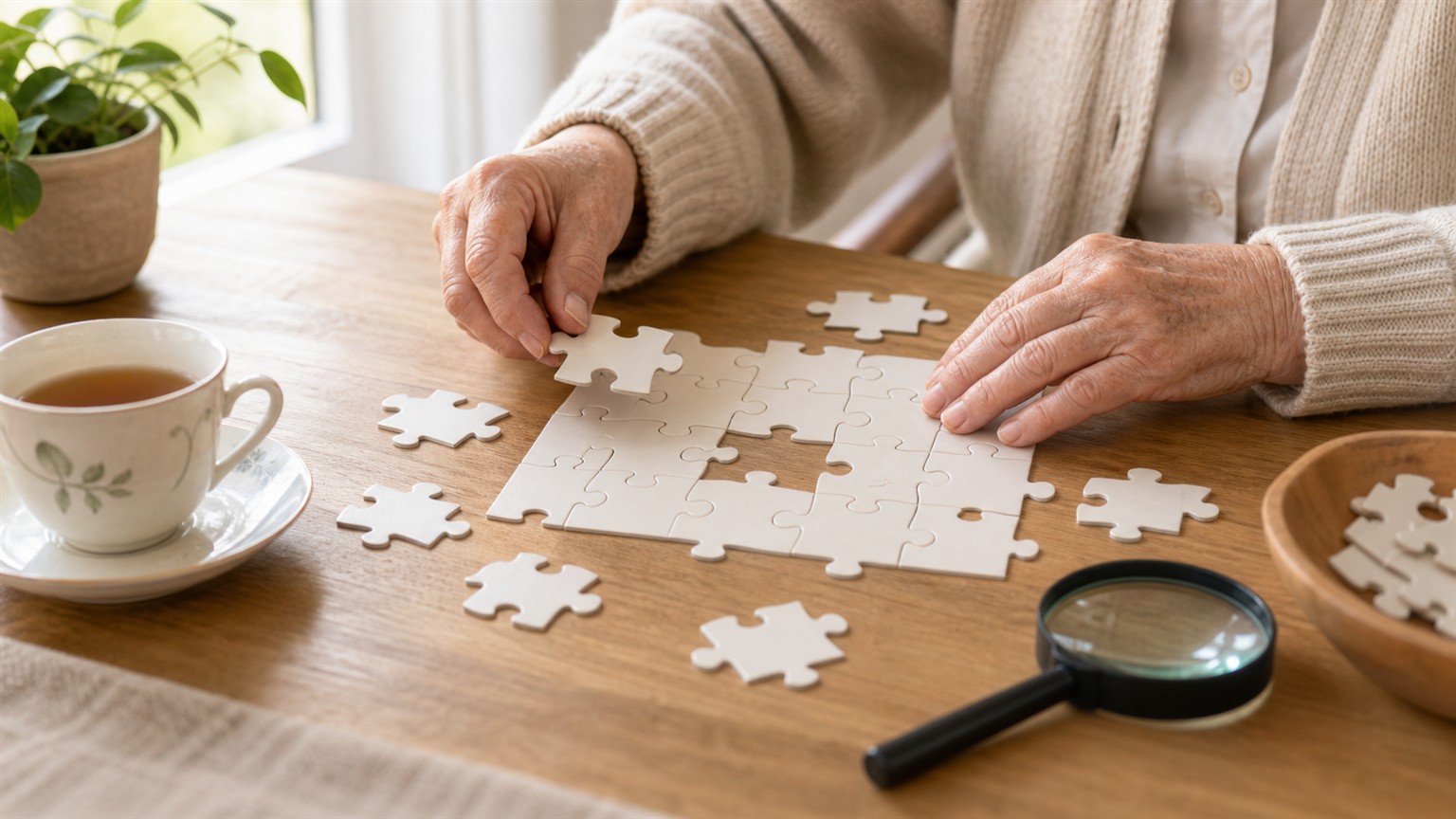
Large-piece jigsaws, high-contrast materials, short word puzzles, familiar themes, and adjustable digital settings can all help. The goal is to keep the cognitive challenge clean rather than letting small print, glare, or awkward pieces become the real obstacle.
How to Build a Responsible Routine
A responsible routine might mix familiar and novel puzzles. Familiar formats reduce the barrier to starting, while new formats add learning and attention. Sessions can be short, and the routine can include social options when they are welcome.
What to Do When Memory Concerns Appear
Puzzles should not be used to dismiss memory concerns. If someone is experiencing persistent confusion, functional changes, or concerning memory loss, professional evaluation is appropriate. A puzzle habit can continue as a meaningful activity, but it should not become a substitute for care.
This distinction protects both the person and the hobby. Puzzles can provide engagement, pleasure, and connection without being asked to perform a medical role they cannot guarantee.
Families can still use puzzles supportively by choosing accessible formats, avoiding pressure, and noticing whether the activity brings calm or frustration.
Reading Headlines With Skepticism
Headlines about puzzles and dementia can be tempting. Look for whether a story describes a study, an expert opinion, or a product claim. Ask whether the article measured dementia diagnosis, cognitive scores, self-reported activity, or something else.
The more dramatic the promise, the more carefully it should be read. Good science usually speaks in probabilities, associations, and limitations. That nuance is not a weakness; it is the reason the advice can be trusted.
Why Cognitive Reserve Is Often Mentioned
Discussions of dementia risk often include the idea of cognitive reserve: the brain's ability to cope with changes or damage while maintaining function. The concept is complex, but the everyday lesson is straightforward. A life with learning, social connection, and mentally engaging activity may give the mind more ways to stay active and adaptive.
Puzzles can belong in that mix because they ask for attention, memory, problem solving, and persistence. They are not the only path to cognitive engagement, and they should not be treated as a special guarantee. Their value is that they are accessible, varied, and enjoyable enough for many people to repeat over time.
The important word is may. Cognitive reserve is not a simple score that a puzzle automatically raises. It is a research concept that helps explain why rich mental activity is worth considering as part of healthy aging.
What a Puzzle Habit Can Realistically Offer
A puzzle habit can realistically offer regular practice with thinking skills. It can give someone a reason to concentrate, recall, compare, plan, and discuss. It can also create a pleasant routine that brings structure to the day.
Those outcomes are meaningful even if they are not the same as disease prevention. A routine that supports attention, confidence, and connection has real quality-of-life value. The mistake is not enjoying puzzles; the mistake is asking them to promise more than evidence can support.
Why Variety May Be Better Than One Favorite
A favorite puzzle is valuable because it keeps people returning. Variety adds another benefit: it spreads engagement across more skills. A crossword leans on language and semantic memory. A jigsaw leans on visual and spatial comparison. A logic puzzle leans on organization and deduction.
A balanced puzzle routine can therefore feel richer than a single repeated format. The solver does not need to abandon the favorite; they can surround it with occasional novelty. That novelty may be especially useful when the goal is broad engagement rather than mastery of one puzzle type.
Variety also reduces discouragement. If one format becomes tiring, another can keep the habit alive.
How Social Factors Complicate the Evidence
Social connection can influence health and wellbeing, and many puzzle settings are social. A person who attends a weekly puzzle group is not only solving puzzles. They are leaving the house, talking with people, sharing attention, and belonging to a routine.
That makes research interpretation complicated. If people who do puzzles show healthier outcomes, the puzzle may be only one ingredient. The social environment around the puzzle may also matter. This is another reason to avoid single-cause claims.
For practical advice, the complication is useful. It suggests that puzzle habits may be strongest when they are connected to people, places, and rituals, not only to isolated performance.
How to Talk About Risk Without Creating Fear
Articles about dementia risk can easily become fear-based. A better tone is practical and respectful. Encourage healthy engagement, recommend medical evaluation for concerns, and avoid implying that people are personally at fault if illness occurs.
Dementia is not a moral failure and not something a person can simply puzzle their way out of. Supportive advice should reduce shame, not increase it. Puzzles can be offered as one meaningful activity within a wider care and health context.
A Balanced Weekly Approach
A balanced week might include a crossword or word puzzle for language, a jigsaw for visual focus, a logic puzzle for reasoning, and one social puzzle activity for connection. The plan can stay loose. The point is not to complete a brain-health checklist, but to create regular, enjoyable engagement.
The best routine is one that respects the person's preferences. If the plan feels like homework, it will not last. If it feels like a pleasant rhythm, it has a much better chance of becoming part of daily life.
Why Accessibility Affects Consistency
A puzzle habit depends on being easy enough to start. If pieces are too small, print is too faint, or the rules are too confusing, the activity may stop before cognitive engagement begins. Accessibility is therefore part of the evidence conversation in practical terms, even when a study does not focus on it directly.
The more comfortable the setup, the more likely a person is to return. Large pieces, good lighting, readable clues, and patient pacing make the puzzle less about battling the materials and more about engaging the mind.
What Families Can Do With the Evidence
Families do not need to treat the evidence as a prescription. They can use it as encouragement to offer meaningful activities. A puzzle table, a shared crossword, or a gentle matching game can become a point of connection without being framed as medical intervention.
The best family approach is respectful. Ask what the person enjoys, adjust the challenge, and avoid turning puzzle time into a memory test. If the activity produces frustration or embarrassment, change the format. The goal is engagement with dignity.
A Research-Aware Summary
A research-aware summary would say this: puzzles are a promising form of cognitive engagement, especially when repeated, enjoyable, accessible, and sometimes social. They may fit into broader healthy-aging patterns, but they do not carry a guarantee against dementia.
That sentence is less dramatic than many headlines, but it is more useful. It lets readers act without being misled.
The Practical Bottom Line
The practical bottom line is encouraging but modest. If a person enjoys puzzles, there are good reasons to keep them in the weekly rhythm. They provide mental effort, feedback, and often social contact. Those are worthwhile features even without a guarantee.
A puzzle habit should sit alongside movement, sleep, medical care, social connection, and other meaningful activities. That balanced framing is the most honest way to discuss dementia risk.
Conclusion: Engagement Without Overpromising
The evidence for puzzles and dementia risk supports a cautious, encouraging message. Puzzles can be part of a cognitively engaging life, especially when they are enjoyable, accessible, varied, and sometimes social. They should not be sold as a guaranteed way to prevent disease.