Executive Function Begins in Small Choices
Executive function is a set of developing skills that helps children hold information in mind, control impulses, switch strategies, plan actions, and manage frustration. Puzzles give young children a concrete place to practice those skills. A child has to remember the goal, resist forcing the wrong piece, try another approach, wait for a turn, or keep going after a mistake. These moments are small, but they are exactly the kind of practice early executive function needs: repeated, supported, playful, and matched to the child's developmental level.
A: It includes developing skills such as working memory, impulse control, flexible thinking, planning, and self-regulation.
A: Children hold the goal, piece locations, and recent attempts in mind while solving.
A: It can look like pausing, rotating a piece, or choosing not to force a wrong fit.
A: Children learn to change strategy when the first attempt does not work.
A: Usually not; gentle scaffolding is better than taking over the thinking.
A: They let children complete a full cycle of effort, feedback, and success.
A: Yes, turn-taking and shared decisions can practice social control.
A: Lower the challenge, offer a small hint, pause, or return later.
A: No, puzzles provide practice opportunities rather than guaranteed broad outcomes.
A: The adult protects playful challenge while helping the child stay regulated.
Working Memory at the Puzzle Table
Working memory lets a child hold the goal in mind while acting. In a puzzle, that might mean remembering the picture, the shape of an opening, or which piece already failed. The information is temporary, but it guides the next move.
Young children need support because working memory is still developing. A clear picture, a small number of pieces, and adult language can reduce overload. The child can then practice remembering the right thing instead of being buried by too many details.
Inhibition Is the Pause Before Pushing
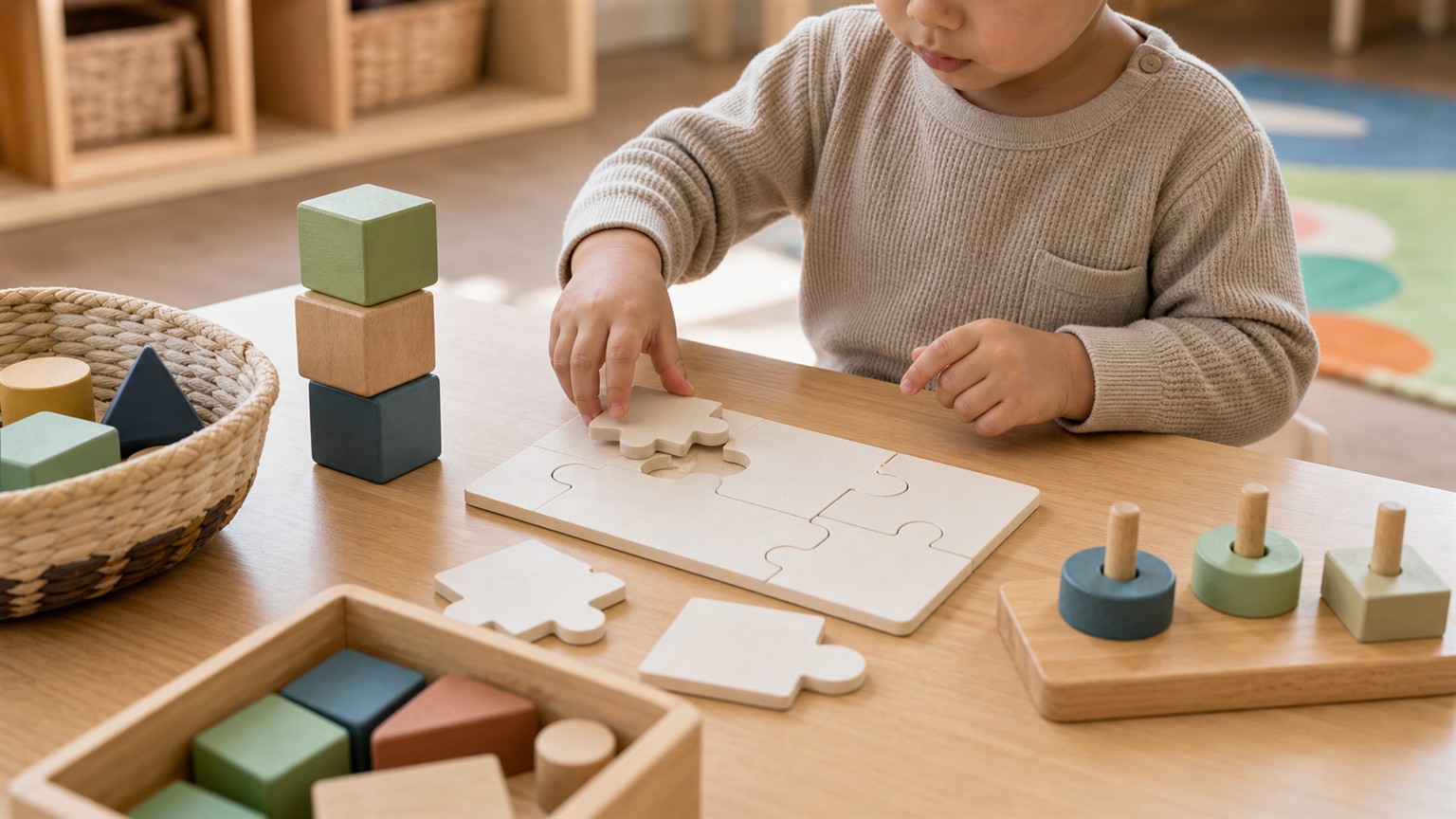
A classic puzzle moment happens when a child tries to force a piece into the wrong place. Inhibition is the pause that allows another option: turn it, compare it, set it aside, or choose a different piece.
Flexible Thinking Grows Through Failed Attempts
Puzzles are useful because wrong attempts are visible. A piece does not fit. A pattern breaks. A maze path stops. The child receives feedback from the materials before an adult has to correct them.
That feedback invites flexible thinking. The child learns that failure is not the end of the activity; it is information. A new strategy can be tried.
Adults can reinforce this by using calm phrases such as let's turn it, what else could match, or maybe this piece belongs somewhere else.
Planning Begins With Where to Start
Planning in early childhood does not need to look elaborate. It may be as simple as choosing the corner pieces first, grouping by color, or deciding to finish one small area. These choices help children see that a puzzle can be approached in steps.
A planned approach reduces random trial and error. It gives the child a sense of control. That feeling can make persistence easier because the next move is not a mystery.
Self-Regulation and Frustration
Puzzles naturally create small frustrations. The important question is whether the child has enough support to stay engaged. Too much frustration can overwhelm learning, while manageable frustration gives self-regulation a place to grow.
The Adult as Coach, Not Solver
Adults support executive function best when they coach rather than solve. A coach notices the child's struggle, offers a prompt, and leaves the decision with the child. A solver takes over the key move and removes the practice opportunity.
Good prompts are specific but not revealing. Try turning it. Look for the same color. Which space has that shape? These prompts guide attention while preserving agency.
The tone matters as much as the words. Calm support teaches children that thinking can continue after difficulty.
Why Repetition Helps
Executive function develops through repeated practice in many settings. Puzzle play can provide repetition without feeling repetitive because the materials, images, and goals can change.
A child who repeatedly practices pausing, remembering, switching, and trying again is building a familiar routine for problem solving. The puzzle is small, but the habit is broad.
Group Puzzles and Turn-Taking
Shared puzzles add social executive function. Children may wait, negotiate, ask, explain, and accept another person's idea. These moments practice self-control in a social context.
Choosing the Right Difficulty
The best executive-function puzzle is not the hardest one. It is the one that creates a manageable need for control. If a puzzle is too easy, the child cruises without much planning. If it is too hard, the child may give up or rely entirely on the adult.
Adjust difficulty by changing piece count, visual complexity, time, or amount of adult support. The same child may need different levels on different days.
A successful session ends with the child feeling capable enough to return.
Digital Puzzles and Executive Function
Digital puzzles can support executive function when they are calm, clear, and interactive in meaningful ways. A good digital puzzle still asks the child to remember, choose, wait, and revise.
However, digital environments can add distractions. Too many animations, sounds, or rewards may pull attention away from the actual thinking. For young children, simple physical puzzles often provide a cleaner practice space.
Why Executive Function Needs Practice Contexts
Executive function develops through use. Children need repeated opportunities to remember a goal, control an impulse, shift attention, and recover from mistakes. Puzzles provide those opportunities in a concrete setting that does not feel like a lecture.
The practice is embedded in play. A child wants the piece to fit, the path to open, or the pattern to continue. That motivation gives executive skills a reason to appear. The child is not practicing self-control in the abstract; they are using it to do something meaningful.
This is why puzzle play can be so useful for adults and educators. It creates small, observable moments where support can be offered at exactly the right time.
Working Memory Looks Like Remembering the Plan
In early childhood puzzles, working memory often looks like remembering the plan. The child may be trying to finish the edge, keep all red pieces together, or remember that round pieces belong in round spaces. These small goals guide action.
Adults can help by making the plan visible. Put the target area nearby, repeat a simple phrase, or point to the shape that is being matched. The child still does the thinking, but the environment supports memory.
Inhibition Can Be Playful
Impulse control is easier to practice when the situation is playful. A child can learn to pause before pushing a piece by pretending to be a detective, checking the shape, or giving the piece a tiny turn. The pause becomes part of the game.
That playful framing matters. If inhibition is taught only through scolding, the child may feel shame rather than control. In puzzle play, the adult can model a calm pause and show that waiting can help the solution appear.
Flexible Thinking Is the Opposite of Stuck
A child who tries the same piece the same way again and again is stuck in one strategy. Flexible thinking begins when they can change something: rotate the piece, try a different spot, sort by color, or ask for a clue.
Adults can support this by naming options. We tried pushing; now let's turn. We looked at color; now let's look at shape. These simple contrasts teach children that there is more than one way to approach a problem.
Over time, flexible thinking becomes less dependent on adult prompts. The child begins to generate alternatives independently.
Emotional Regulation Is Part of the Task
Executive function is not only cognitive; it is emotional too. A child has to manage disappointment when something fails, excitement when progress appears, and impatience when a turn is delayed. Puzzle play offers small, manageable doses of these feelings.
The adult's calm presence helps. A child who hears that mistakes are useful and breaks are allowed learns that frustration can be survived. This emotional safety makes it easier for executive skills to stay online.
Observation Before Intervention
Adults often want to help quickly, but observation should come first. Is the child productively experimenting, or are they becoming overwhelmed? Are they close to noticing the solution, or repeating a failing move without awareness? The answer determines the support.
A well-timed hint can preserve learning. A premature solution can remove it. The adult's role is to keep the child in the zone where effort still belongs to them.
The Value of Waiting
Waiting is a surprisingly important puzzle skill. A child waits while another person takes a turn, waits before forcing a piece, or waits while checking whether a plan is working. These short pauses are executive-function practice in miniature.
Adults can make waiting easier by keeping it purposeful. Instead of saying only wait, they can say watch what shape she tries, or hold your idea and then we will test it. The pause becomes active attention rather than empty delay.
Why Choice Supports Self-Regulation
Choice can support self-regulation because it gives the child ownership. Would you like to start with corners or colors? Do you want to try the maze or the matching cards? Small choices help children feel involved before frustration appears.
Choice should be limited enough to be manageable. Too many options can overload young children. Two clear choices often work better than a whole shelf of possibilities.
When children choose, they are more likely to persist because the activity feels partly theirs.
Turning Cleanup Into Executive Practice
Even cleanup can support executive function. Sorting pieces back into a box, checking that all parts are present, and putting materials away in order all require planning and attention. The puzzle session does not have to end the moment the picture is complete.
A calm cleanup ritual also teaches transition skills. The child moves from focused play to closure without a sudden emotional drop. That transition is part of self-regulation.
Linking Language to Control
Language helps children control attention. A child who can say turn it, try another, edge piece, or not yet has more tools for guiding behavior. Puzzle talk gives those control words a practical setting.
Adults can model short phrases that children later use privately. Over time, spoken guidance can become internal guidance. That is one path from shared problem solving to self-regulation.
Why Small Successes Matter
Executive function practice should include success. A child who repeatedly experiences effort leading to progress is more likely to try again. The success does not have to be dramatic. One matched shape, one completed corner, or one calm pause can count.
Small successes also help adults calibrate difficulty. If there is no progress, the puzzle may be too hard or the support too thin. If progress is instant, the puzzle may not ask for much control.
Making Executive Function Visible
Adults can make executive function visible without turning play into a lesson. They might say, you remembered where that piece was, or you stopped and tried a new way. These comments name the skill in ordinary language.
Naming the skill helps children understand what worked. The praise is not only you are smart. It becomes you used a strategy, you waited, you checked, you tried again. That kind of feedback supports a growth-oriented puzzle habit.
Conclusion: Playful Practice for Control Skills
Puzzles support early executive function by creating small, repeatable moments of memory, inhibition, planning, flexible thinking, and self-regulation. Those skills grow best when the challenge is playful and the adult support is respectful.
The goal is not to turn childhood puzzling into a formal lesson. The goal is to protect the kind of play where children can think, try, pause, adjust, and feel proud of effort.